


Position sizing is simply deciding how much money to put into a trade, but that description undersells it. It’s one of the most consequential decisions in all of risk management. A trader can have a genuinely good read on a stock, identify the right chart structure, build a solid thesis, and still lose money if the position is sized wrong. You can be right about the direction and still lose the trade.
Size affects everything: how much capital is at risk, how clearly you’re able to think when the trade moves against you, whether normal intraday volatility feels routine or feels like a crisis. More than anything, it determines whether you can actually follow the plan you made before entering, or whether fear takes over and you abandon it.
A good idea with bad sizing can become a bad trade. That’s not a hypothetical. It happens constantly.
Size Changes the Trade
The same stock can feel completely different depending on how much of your account is in it. A small position is easy to hold through normal movement, a red day registers, you note it, you move on. Put too much in and every down candle starts to feel like an emergency, even when nothing about the company or the chart has actually changed. The thesis is the same. The setup is the same. Only the size is different.
That’s why position sizing isn’t purely mathematical. It’s psychological. A position needs to be sized in a way that lets you think clearly and stick to the plan you made before you entered. If the size is making you emotional, the trade is already harder to manage than it needs to be.
Risk Is Not the Same as Position Size
These two are related, but they’re not interchangeable, and confusing them is an expensive mistake.
If you put $10,000 into a stock, that doesn’t mean you’re risking $10,000. Your actual risk depends on where the trade is invalidated, where the chart tells you the setup is no longer valid — and how much you’re prepared to lose before you exit.
Say you buy a stock at $100 and your invalidation level is $90. Your risk is $10 per share. If you buy 100 shares, your position size is $10,000, but your planned risk is $1,000.
100 shares × $10 risk per share = $1,000
That’s the number that matters. Position size is how much capital is in the trade. Risk is how much of that capital you’re prepared to lose if you’re wrong.
Start With the Loss, Not the Gain
A lot of newer traders size a trade by working backward from what they hope to make. “If this doubles, I could make $5,000.” It’s a natural way to think, but it’s the wrong starting point.
The right question is: if I’m wrong, how much am I willing to lose?
That question forces discipline. It keeps one exciting setup from eating up too much of the account. Before you think about upside, you need to know exactly what the downside looks like, and you need to decide whether you’re actually comfortable with that number before you enter. A trade isn’t properly sized until the potential loss is something you can live with, not just tolerate in the moment.
The Percentage Risk Method
One of the most common frameworks for managing this is to risk only a fixed percentage of your account on any single trade, typically somewhere between 0.5% and 2%, depending on the trader and the setup. The idea is that no single loss should be able to meaningfully damage the account.
Here’s how it works in practice. Suppose you have a $50,000 account and you’ve decided to risk no more than 1% per trade. That’s $500. You’ve identified a setup where your stop is $5 below your entry. That dictates your share count:
$500 ÷ $5 risk per share = 100 shares
If the stop is wider, say $10 per share, the position gets smaller:
$500 ÷ $10 risk per share = 50 shares
That’s the relationship to internalize: the wider the risk, the smaller the position. The tighter the risk, the larger the position can be, assuming the invalidation level is technically sound and not just wishful thinking.
Wider Stops Require Smaller Positions
Some trades legitimately require more room. A volatile stock, a longer-term swing, a speculative name with thin float, these can move hard even when the thesis is intact. That doesn’t make them bad trades. It means the position size has to reflect the volatility.
This is where a lot of traders get into trouble. They give a trade a long-term thesis but size it like a short-term scalp. Then when the stock moves 10% against them in a week, normal behavior for certain names, it feels unbearable. They cut the position at exactly the wrong time, not because the trade failed, but because the size made the volatility feel intolerable.
The problem wasn’t the idea. The problem was the size.
Concentration Risk
Concentration risk is what happens when too much of the account depends on a single position, sector, or thesis, sometimes without the trader even realizing it.
You might think you’re diversified because you hold several different tickers. But if those tickers all depend on the same underlying narrative, the account may still be highly concentrated. Owning five semiconductor stocks looks like diversification until the SOX breaks down and they all sell off together. Owning several speculative tech names may look like a spread of bets, but if they’re all high-beta names levered to the same macro environment, they’ll behave like one large trade when things get difficult.
Position sizing isn’t just about individual trades, it’s also about how all your positions interact with each other when conditions change.
Conviction Does Not Remove Risk
This one is worth sitting with. High conviction is not the same as high certainty.
You can believe strongly in a stock and still be wrong, or early, which in some setups amounts to the same thing. The market can take longer than your thesis assumes. A catalyst can fail or get delayed. A company can dilute shareholders or miss guidance. The sector can fall out of favor. Even when you’re ultimately right, a trade can go through a painful drawdown that forces most people out before the move develops.
Confidence is worth something, but it needs to be balanced against actual risk: the volatility of the name, the liquidity, the time horizon, and what the chart looks like if the thesis fails. A trade shouldn’t be allowed to become dangerous just because you feel strongly about it. The feeling and the risk are separate things.
Averaging Down
Averaging down (buying more after a stock drops) can be a reasonable tactic, but the reason behind it matters enormously.
Sometimes it makes sense: the thesis is still intact, the technicals haven’t broken down, and the original trade plan included the possibility of adding on weakness. That’s disciplined averaging down. Other times, traders add to losing positions because the stock feels cheaper, or because they can’t bring themselves to admit the trade is failing. Those are very different situations.
Before adding to a losing position, it’s worth asking a few honest questions: Has the thesis actually improved, or is this just a cheaper price? Was this add part of the plan before the trade was opened, or is it a reaction to being down? Would you buy this stock today if you didn’t already own it? Has anything been technically invalidated?
Averaging down without a plan is one of the cleaner ways to turn a manageable loss into a serious problem.
Scaling In
Rather than committing the full position at once, many traders build their exposure gradually, buying a partial position first, then adding if the setup confirms. This approach reduces the pressure of needing a perfect entry, and it allows the trader to be involved without having their full risk on the table from the start.
A common version of this: take a one-third position initially, add another third on a pullback to support, and complete the position once the setup confirms momentum. The flexibility is real, it keeps capital available and allows the trader to respond to what the chart actually does rather than what they hoped it would do.
The important caveat is that scaling in still requires a pre-defined limit on total position size. Without that ceiling, scaling in can quietly become uncontrolled averaging down.
Scaling Out
Scaling out is the mirror image: selling the position in pieces rather than all at once. The main benefit is that it gives a trader a plan before emotions get involved. If a trade is working and you’ve already decided you’ll take partial profits at a certain target, you don’t have to make that decision under pressure.
Taking profits on a portion of the position locks in some gains while keeping exposure to further upside. It’s not a perfect system, selling too early limits gains, and holding too much can give back profits, but there’s no perfect answer to that tension. What scaling out provides is structure: a way to act based on a pre-made plan rather than in-the-moment emotion.
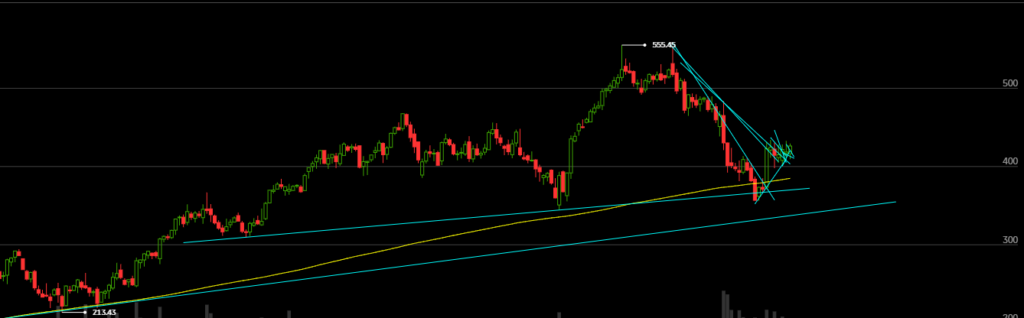
Many traders were watching the 200-week moving average closely on MSFT, shown here by the yellow line. Historically, Microsoft has respected this level for nearly 20 years, which makes it an important long-term reference point.
But the proper way to approach a trade like this is not necessarily to go all-in at one exact price. A more balanced approach is to scale in as price approaches the moving average, using smaller capital allocations near, at, or even slightly below the level, until the level is clearly lost.
In this case, the 200-week moving average was ultimately respected and the stock began to recover. But anyone who deployed their entire position at or slightly above the moving average likely had to sit through a very stressful test beneath it. Being oversized too early could cause you to abandon what would end up being a winning trade.
Not every trade needs to be all-or-nothing at one price.
Sometimes the better approach is to nibble, watch the reaction, and let the chart confirm or invalidate the trade. This keeps you involved without letting one entry point control your entire position.
Options and Position Sizing
With options, position sizing becomes even more critical. Options can move dramatically faster than shares. A 3% drop in a stock might cause a short-dated call option to lose 40% or more of its value. Add in time decay and changes in implied volatility, and the range of outcomes is far wider than with shares alone.
Because of this, options positions generally need to be smaller than equivalent equity positions. The fact that you’re comfortable risking a certain dollar amount in shares of a company doesn’t mean that same dollar amount is appropriate for short-dated options on the same company. Options can produce large gains, but they can also go to zero before expiration. That possibility should be reflected in how much you put in.
Leverage Makes Sizing More Important
Margin and leverage amplify both outcomes, gains and losses. A leveraged position may look manageable while the trade is working, but when it moves against you, losses can compound quickly. There’s also the mechanical risk of forced selling if margin requirements tighten at the worst possible time, exactly when you’d want the most flexibility.
The more leverage in a trade, the less room for error. Aggressive sizing without leverage is uncomfortable. Aggressive sizing with leverage can be genuinely damaging to an account.
The Sleep Test
Here’s a simple gut check: can you sleep with the position on?
If you’re checking the stock constantly, lying awake thinking about it, or feeling physically sick over normal intraday movement, the position is probably too large. That’s not necessarily a comment on the trade itself, the idea might still be sound, the chart might still look fine. The size might just be wrong.
A well-sized position should matter to the outcome. It just shouldn’t control your judgment. If it’s so large that it starts affecting how clearly you think, following your plan becomes much harder.
The Big Picture
Position sizing determines how much damage any single trade can do to the account. It determines how emotional a trade feels in the moment. It determines whether you can survive being wrong without blowing up the account or losing your conviction at the worst time.
Good position sizing gives a trade room to work without putting the account in serious danger. Poor position sizing can turn a normal pullback into panic, a small mistake into a large loss, or a genuinely good thesis into an emotional burden you can’t hold.
The goal isn’t to make every trade as large as possible. The goal is to make every trade survivable — because once the size gets too large, the trade stops being about analysis and starts being about fear.