


What Is Elliott Wave Theory?
Elliott Wave Theory was developed by Ralph Nelson Elliott in the 1930s. Elliott believed that markets move in recognizable wave patterns driven by investor psychology. Before proceeding, Elliot Wave Theory can be subjective, and is not always precise. It is less about predicting exact price levels and more about anticipating broader market moves.
The basic structure is made up of two phases:
- Impulse waves, which move in the direction of the main trend.
- Corrective waves, which move against the main trend.
The most common Elliott Wave structure is a five-wave move followed by a three-wave correction.
In a bullish trend, that means price often moves upward in five waves, then corrects downward in three waves.
The structure looks like this:
Wave 1: Initial move up
Wave 2: Pullback
Wave 3: Strong continuation move
Wave 4: Consolidation or correction
Wave 5: Final push higher
Wave A: First corrective move down
Wave B: Relief bounce
Wave C: Final corrective move down
Example
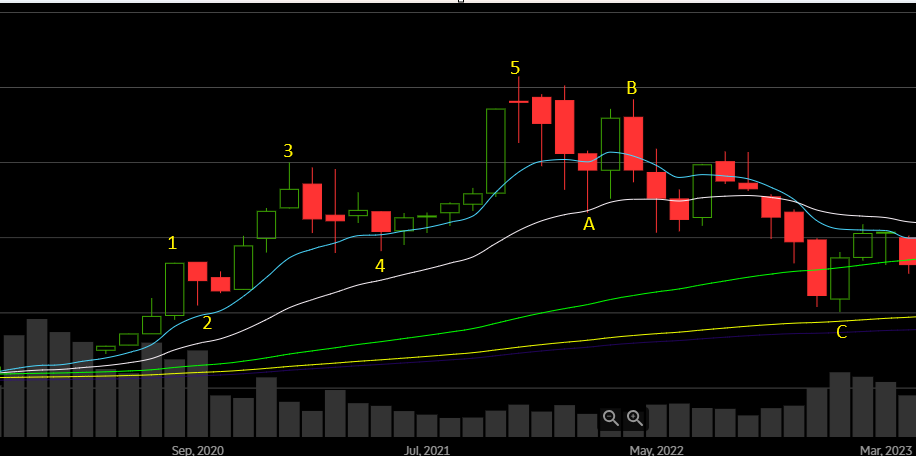
Example of a full 5 wave and ABC pull-back for Tesla (TSLA) ranging from April 2020 until December 2022. Monthly candles are depicted for this example.