


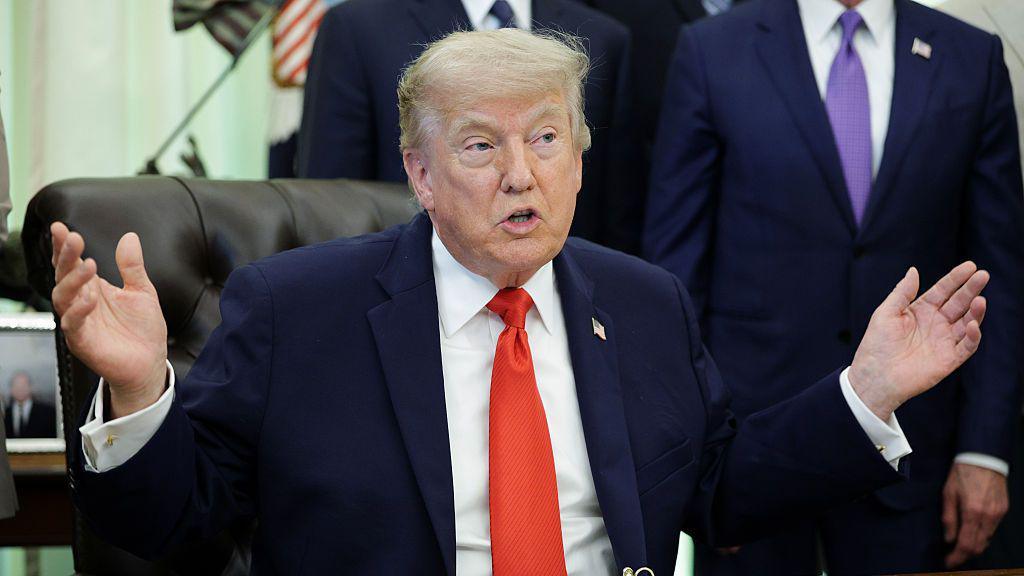
Sunday night the tape flipped. Trump announced a framework deal with Iran, authorized the toll-free reopening of the Strait of Hormuz, and ordered the naval blockade lifted. Iran’s Supreme National Security Council confirmed the wording of a memorandum of understanding, set to be signed June 19 with a 60-day window to formally end the war. Asia gapped. The Nikkei ripped 5.5 percent, the Kospi 5.7 percent. By the U.S. open the S&P had tagged a fresh record near 7,543, the Dow printed a new all-time high around 51,725, and the Nasdaq surged better than 2 percent. Brent fell almost 5 percent toward $83, WTI cratered 5 percent to around $80, its lowest since early March.
So the question every one of us is sitting on this morning is the only one that matters: do you chase this, or do you fade it? Is this the start of a lockout rally where the bears never get a clean re-entry, or is this the exact kind of euphoric gap you sell into?
Here is how I am actually thinking about it, and what I am doing with my own book.
What actually happened versus what the tape is pricing
The tape is pricing peace. The reality is a framework, not a signature. There is a difference, and it is the whole trade.
A memorandum of understanding is an agreement to agree. The document gets signed Friday, the war is supposed to wind down over 60 days, and the strait is supposed to reopen. Notice the layered conditionality. This is the same administration that, since February 28, has repeatedly announced pauses and extensions right before its own deadlines, then resumed strikes when talks stalled. The June 9 and 10 strikes happened with a Qatari delegation physically on the ground in Tehran. I am not saying the deal breaks. I am saying the market has marked it to “done” while the actual state of the world is “probably, in stages, if it holds.”
The second thing the tape is glossing over is that reopening the strait on paper does not reopen it in practice. As of yesterday morning, with Trump posting that ships were “starting to move,” the independent monitors counted two vessels actively transiting. Two. Normal flow is around 60 a day. Shipowners, insurers, and crews are not going to send tonnage through a chokepoint that was a live combat zone last week on the strength of a Truth Social post. Eurasia Group’s read is that it may take several weeks just to get back to 50 percent of pre-war throughput. There is a physical re-rating coming in oil, but it is going to be a grind, not a switch.
That gap between the headline and the plumbing is where the opportunity and the trap both live.
Oil: WTI is sitting exactly on the 200-day, and that is the whole question
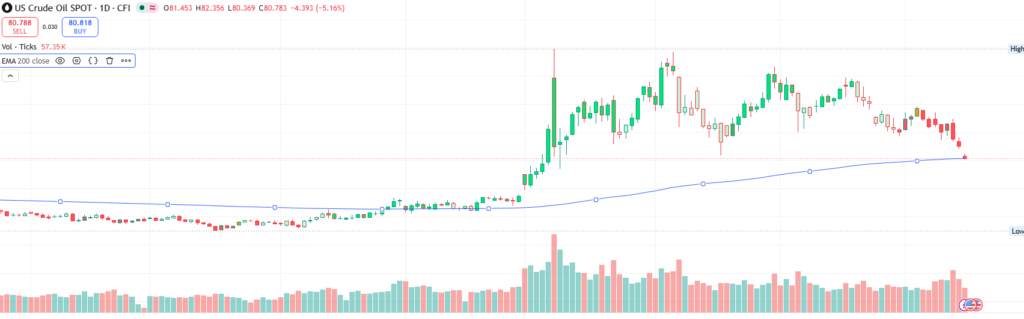
With a commodity like oil I trade mechanism, not narrative, and oil is the most mechanical thing on this board. Yesterday’s 5 percent flush dragged WTI down to around $80.50, and look at where that lands it: right on the 200-day EMA at $80.79. Not near it. On it. The single most-watched mean-reversion line in the commodity, and price is pinned to it the morning after a peace gap.
That level is doing real work, because it is the line that separates two completely different worlds. Above it, you are still in the war regime, where the supply shock removed barrels from the market and the bid was structural. Below it, you are telling yourself the entire war premium was temporary and crude reverts toward where it started the year. WTI spiked above $117 intraday at the peak of the crisis. The strait carries roughly a fifth of global crude, and the IEA pegged the blockade’s daily shortfall at about 14 million barrels. That premium was real because the barrels were physically gone. The deal is now trying to give them back, and the 200-day is exactly where the market is adjudicating whether that hand-back is real or premature.
Here is what makes the level so clean right now. The front-month collapsed 5 percent on the deal, but the longer-dated contracts barely moved. Brent for delivery out through February 2027 sat right around $80 even after the announcement. So the back end of the curve is sitting at roughly the same place as WTI’s 200-day. That is not a coincidence, it is the market drawing the same line twice. The back end is saying normalization is slow and a floor forms somewhere in the low $80s. The 200-day is saying the same thing from the technical side. When two independent reads on the structure agree on a level, I pay attention.
So the trade reduces to one question I can actually watch tick by tick. Does WTI hold $80.79 as support, or lose it? Hold it, and the front end and back end converge from above, the war-premium floor is confirmed higher than the bears think, and everyone who shorted the gap is offside. Lose it with conviction, and the front end keeps chasing the back end lower, the supply shock is officially priced as over, and the disinflation trade gets real legs right into the Warsh meeting. That is a binary I can build risk around without guessing at the headline.
What I am watching: the actual transit count, not the rhetoric. hormuzstraitmonitor and Lloyd’s List are the real data. When the vessel count climbs from two toward twenty toward forty, that is your confirmation the physical unwind is real. Until then, every sharp down day in crude on a fresh peace headline is suspect, because the molecules have not moved yet.
What I am cautious of: getting cute shorting oil here. The easy money on the long side was the spike. The easy money on the short side was yesterday’s gap. From here it is a two-sided grind tied to a deal that could re-rupture on a single Lebanon strike. Iran’s stated tripwire all along has been continued operations in southern Lebanon. That tripwire is still armed.
Stocks: this is a relief rally on top of an inflation problem
The equity move makes total sense as a first-order reaction. Lower oil, war ending, risk premium bleeding out, growth and rate-sensitive names catching a bid. The Nasdaq leading tells you exactly what it is. This is the same trade I have been mapping for months, the AI complex as the load-bearing wall of the bull case, getting a geopolitical excuse to extend.
But step back. We just printed 4.2 percent headline CPI for May, the hottest since 2023, and over 60 percent of that monthly increase was energy. Gasoline was up better than 40 percent year over year. The market is now celebrating the removal of the exact input that was driving the print it has not even fully digested yet. That is the bull case in one sentence: peace lowers oil, lower oil cools the energy-driven part of inflation, cooler inflation reopens the door to easier policy, and the whole thing is rocket fuel for multiples.
The bull case is real. It is also exactly the kind of clean story that shows up at local tops.
Here is the tension I cannot get past. Strip energy out of that 4.2 percent and core was a tame 0.2 percent on the month, below the 0.3 percent consensus. So if oil normalizes, the headline mechanically falls and the inflation scare deflates. That argues for the lockout-rally case. The problem is the timing. Capital Economics flagged it plainly: even if the strait reopens immediately, it does not stop inflation rising a bit further near term and does not avoid economic damage in Q3. Energy works with a lag. Gasoline at the pump does not drop the day a tanker leaves the Persian Gulf.
So you have a market pricing the disinflation before the disinflation shows up, into a Fed meeting where the chair has every incentive not to validate it.
The Warsh meeting is the actual catalyst, and the timing is brutal
This is the part of the setup I think most people are underweighting because the Iran headline is louder. The FOMC decision lands Wednesday, June 17, at 2:00 ET, with the press conference at 2:30. It is Warsh’s first meeting as chair, and it is a quarterly projection meeting, so we get a fresh dot plot and Summary of Economic Projections.
The rate itself is a non-event. FedWatch has the hold at 3.50 to 3.75 percent at essentially 100 percent. Nobody is moving Wednesday. Everything that matters is in the projections and in how Warsh talks.
Three things I am watching, in order of importance:
The dot plot. In March the dots still showed one small cut for 2026. With headline at 4.2 percent and the risk now skewed toward a hike, the June update could erase that last cut entirely or even pencil in an increase. Fed funds futures already flipped, with roughly a 70 percent implied probability of at least one hike by December. If the dots confirm zero cuts, that is a hawkish repricing the equity tape has not fully made room for in its victory-lap mood.
Whether the dot plot even survives. Warsh has openly questioned the usefulness of the dot plot. There is real chatter he scraps it or restructures it as soon as this meeting. If he kills forward guidance and tells the market to stop being spoon-fed a path, that is a regime change in how the Fed communicates. Less guidance means more volatility, because the market loses the crutch it has leaned on for a decade. That is not inherently bearish, but it is a vol event.
The framing. This is the one that fits my whole macro read. Warsh walks in with 4.2 percent inflation, a president publicly demanding cuts, and bond vigilantes pushing yields higher until “something breaks.” His entire credibility problem is the 1970s ghost. If he is seen caving to political pressure, the dollar weakens, inflation expectations un-anchor, and the long end sells off, which is the opposite of what equities want. So his strong incentive is to come out neutral-to-hawkish and protect institutional credibility, exactly when the market is leaning the other way on the back of the oil drop.
Put it together. The Iran deal hands the market a dovish narrative on Sunday. The Fed has every reason to lean against that narrative on Wednesday. Those two forces are pointing in opposite directions inside a 72-hour window, and the equity tape is currently positioned for only one of them.
So, sell the rip or lockout rally?
My honest answer is that it is neither cleanly, and pretending otherwise is how you get chopped up.
The case for lockout rally: oil normalizes, the energy-driven inflation scare deflates, core was already tame, war risk premium bleeds out, and the AI complex extends with a fresh tailwind. If Warsh threads the needle and sounds measured rather than hawkish, the bears genuinely may not get a clean re-entry and the indices run.
The case for sell the rip: the deal is a framework, not a signature, with an armed tripwire in Lebanon. The strait is two ships, not sixty. Inflation is still going up near term regardless. And the chair has every incentive to disappoint the dovish read on Wednesday. That is a lot of “priced for perfection” sitting on top of a gap-up into a known binary event.
What I am actually doing. I am not chasing the gap. Buying a record-high open the morning after a one-way Asia session, two days before a projection-meeting FOMC under a brand-new hawkish-leaning chair, is the textbook FOMO entry I have spent the last year building guardrails against. The reward for chasing is small and the binary risk Wednesday is large. That is a bad trade regardless of which way it resolves.
I am letting Warsh print first. The dots and the tone on Wednesday resolve far more of this than the Iran headline did. If he comes out neutral and the market is still standing, the lockout case strengthens and I have a cleaner, lower-FOMO entry on the other side of the event. If he comes out hawkish and the relief rally gives back the gap, that is the sell-the-rip confirmation and I am glad I did not pay record-high prices for it.
I have two real-time tells I am watching while I wait. The first is WTI and that 200-day at $80.79. Hold it and the war-premium floor is real, which quietly undercuts the disinflation story the equity bulls are leaning on. Lose it and the energy tailwind for the lockout case gets a lot stronger, but so does the odds that Warsh looks at falling oil and still refuses to validate cuts. The second is the strait transit count, which tells me whether the oil move is physical or just narrative. Both of those resolve on the tape, not on a press release, and that is exactly why I trust them more than the headline. I am keeping my dry powder against those defined triggers rather than against a Truth Social post.
The deal is the story everyone is trading this morning. The Fed is the catalyst almost nobody is positioned for. I would rather be early to the thing the crowd is ignoring than late to the thing the crowd already bought.
