Editor’s note: This piece is more opinion than our usual market commentary. The numbers in it are real and sourced, but the conclusions I draw from them are my own read of the situation, not settled fact. Take it as one trader’s argument, not gospel. Decisions from you, as always.
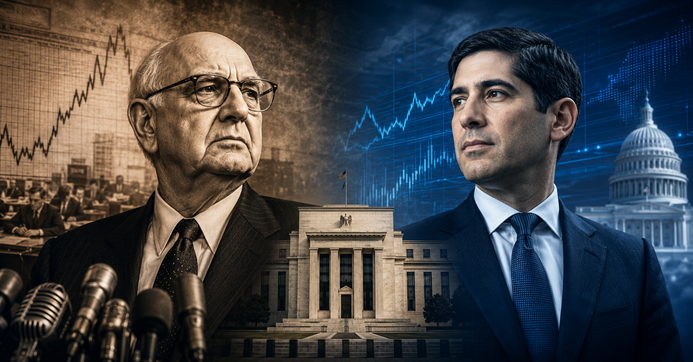
Every time inflation gets uncomfortable, somebody starts reaching for the Volcker comparison. The market wants a hero. It wants the steely central banker who walks in, jacks rates to the moon, eats a recession, and breaks the back of inflation through sheer willpower and credibility. With Kevin Warsh now sworn in as the 17th chair of the Federal Reserve, confirmed in the closest and most divisive vote in the central bank’s modern history, the hagiography has already started. Hawkish reputation. Called for “regime change” at the Fed. Wants to roll off the balance sheet faster. The setup practically writes itself.
I am here to tell you the comparison is dead on arrival. Not because of anything about Warsh the man, his resume, or his convictions. It is dead because the institution he runs is no longer capable of doing what Volcker did. The Fed in 2026 is a paper tiger, and the thing holding the leash is the debt-to-GDP ratio. This is my opinion, but I think the arithmetic backs it up better than most people want to admit.
What Volcker actually had that Warsh does not
Let’s be honest about what made the Volcker shock possible, because it gets romanticized into a story about courage when it was really a story about fiscal headroom.
When Volcker took the federal funds rate to its peak of roughly 20 percent in June 1981, the United States was carrying a public debt of somewhere around 33 to 35 percent of GDP. That number matters more than almost anything else in the story. It meant the government could absorb brutally high interest rates without the cost of servicing its own debt spiraling out of control. Volcker could inflict 20 percent rates on the economy, trigger the deepest recession since the Great Depression, send unemployment to 10.8 percent, and the Treasury’s interest bill, while painful, did not threaten to consume the entire federal budget. The pain landed on households, on the housing market, on the auto industry, on Rust Belt manufacturing. It did not land fatally on the government’s own books.
That is the part everyone forgets. Volcker’s credibility was real, but credibility is cheap when you can afford the consequences. He had a balance sheet that could take the hit. He had a federal government whose solvency did not depend on rates staying low. He had room to be a hero.
Warsh has none of that.
The number that changes everything
As of this spring, US debt held by the public crossed above the size of the entire economy for the first time since World War II. Depending on which measure you use, the ratio sits somewhere between just over 100 percent and roughly 123 percent. Either way, it is three to nearly four times the burden Volcker operated under. That is not a rounding difference. That is a different universe.
Here is what that does in practice. Annual interest on the national debt has now blown past one trillion dollars. It is running around 88 billion dollars a month. It already exceeds what the country spends on national defense, a threshold first crossed in 2024 and now a sustained feature of the budget rather than a blip. More than one in seven federal dollars goes to servicing debt. The weighted-average interest rate on all that Treasury debt is only around 3.35 percent, and it is already producing a trillion-dollar interest bill.
Now run the Volcker experiment forward. Imagine Warsh decided to be the hero the market keeps asking for. Imagine he took the funds rate even halfway to Volcker’s 20 percent. The interest expense on a 39-trillion-dollar debt pile at those rates would not be painful, it would be catastrophic. It would crowd out everything. Defense, Social Security, Medicare, every discretionary line in the budget would be competing with the interest payment, and the interest payment wins because default is not an option. The higher rates go, the faster the debt compounds, the more you have to borrow just to pay the interest on what you already borrowed. That is the convexity problem, and it is the wall every modern Fed chair runs into whether they admit it or not.
This is why I keep saying the debt-service dynamic is a practical ceiling on rate hikes. It is not a theory. It is the reason a Volcker-style campaign is mathematically off the table no matter who holds the gavel.
A paper tiger has teeth it cannot use
I want to be precise about what I mean by “paper tiger,” because it is easy to misread. I am not saying the Fed is powerless or that Warsh is weak. I am saying the institution now possesses tools it can no longer use at full strength, and a market that figures this out stops being afraid of the growl.
Warsh can talk hawkish. He can roll off the balance sheet. He can hold rates steady, as the FOMC just did in June, keeping the target in the 3.50 to 3.75 percent range. He can give speeches about a new framework for assessing inflation. What he cannot do is the one thing that defined Volcker: accept unlimited pain to restore price stability, because the pain now routes straight through the federal government’s own solvency before it ever finishes its work on inflation. The transmission mechanism has been compromised by the size of the debt itself.
And there is a political layer underneath the fiscal one that makes it worse. Warsh arrives having been openly championed by an administration that has spent over a year demanding lower rates and attacking his predecessor for keeping them too high. The confirmation came amid fresh inflation data that, in any prior era, would argue for caution or tightening. The pressure on this Fed does not run toward Volcker-style resolve. It runs the other direction, toward accommodation, toward finding reasons to ease, toward whatever keeps the debt serviceable. When the fiscal math and the political pressure both point the same way, betting on a sudden outbreak of hawkish discipline is betting against the whole structure.
Why this matters for how you position
I am not going to pretend this is a precise trading signal, because it is not. It is a regime read, and regime reads are slow. But the implication is one I have built my whole framework around, so I will state it plainly.
If the Fed cannot hike its way out of inflation the way Volcker did, then the real return on holding dollars and dollar-denominated paper is structurally compromised over time. The release valve for a government that has borrowed past the point where it can tolerate high rates is not default and it is not austerity. Historically it is debasement, letting inflation run a little hot and grinding down the real value of the debt while keeping nominal rates suppressed below where honest price stability would require them. That is the playbook a debt-shackled central bank ends up running, not because anyone announces it, but because every other door is mathematically closed.
That is the entire case for hard assets that sit outside the system. It is why I hold physical gold and silver as an allocation I accumulate and never trade. They are not a bet on a chart. They are a bet that the Fed’s hands are tied, that the Volcker option is gone, and that the long-run answer to a debt this size is to inflate it down rather than to break it the hard way. You do not need to agree with me. But look at the numbers Volcker had versus the numbers Warsh has, and ask yourself honestly whether the hero story is still available to anyone sitting in that chair.
The bottom line
Kevin Warsh may turn out to be a perfectly competent Fed chair. He may be hawkish by temperament and sincere in his convictions. None of that changes the structural reality. Volcker operated a Fed that could afford to be brave because the country owed a third of what it produced. Warsh operates a Fed that owes more than the country produces and spends more servicing that debt than it spends defending itself. The tool that made Volcker a legend is the same tool that would now blow a hole in the federal budget if it were used at anything close to that scale.
So when the next pundit invokes Volcker, remember what Volcker actually had. It was not just nerve. It was room. And room is the one thing this Fed does not have, and cannot get back without first dealing with a debt that no one in Washington shows any appetite to confront.
The Fed still roars. I just no longer think it can bite the way it used to.