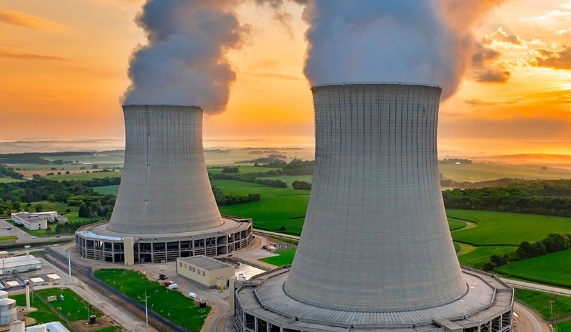
Every gold rush needs a power source, and the AI buildout is the biggest gold rush in a generation. The hyperscalers are committing hundreds of billions to data centers, and all of that compute is useless without electricity to run it. That single fact has turned energy from a sleepy utility backwater into one of the most contested investment themes on the board. The demand is not theoretical and it is not gradual. Data center power consumption is scaling from gigawatts to multi gigawatts, projections have AI data centers roughly quadrupling their power draw toward sixteen hundred terawatt hours by the mid 2030s, and one bank’s framing is that hyperscaler capital spending is already eating nearly all of these companies’ operating cash flow. The grid was not built for this, and everyone in the energy complex knows it.
So a race is on to supply the electrons, and three technologies sit at the center of the conversation. Solar, nuclear fission, and nuclear fusion. Each has a genuine bull case, each maps onto the AI demand story differently, and the smart move is not to crown a winner this early but to understand what each one is actually promising. Here is the case for all three, told the way its believers tell it.
Solar: the only thing you can build fast enough, right now
The bull case for solar starts with a brutally practical observation. AI demand is here today, and solar is the one source you can actually deploy at scale on the timeline the demand is arriving. You do not wait a decade for permits and construction. Panels go up in months, and the manufacturing base already exists at enormous scale. While nuclear projects talk about coming online in the late 2020s and early 2030s, solar farms are being energized now.
The cost story is the backbone of the thesis. Solar has gotten dramatically cheaper over the past decade, and paired with battery storage that has itself fallen something like ninety percent in cost over ten years, the old knock against solar starts to soften. The intermittency problem, the fact that the sun does not shine at night, is the obvious objection, and the solar bulls answer it with storage. Grid scale battery installations of five hundred megawatts and more are now going in next to data center campuses, smoothing the supply so the compute does not care whether a cloud passed overhead. The demand side is already voting with contracts. Leading AI companies have signed at least a dozen large solar agreements, each adding over a hundred megawatts of capacity, because solar plus storage is available, financeable, and fast.
The way a solar believer frames it for this moment: nuclear is the elegant long term answer, but elegance does not train a model this year. Solar is the bridge that is actually load bearing while everything else is still under construction, and bridges have a way of becoming permanent. The technology is proven, the supply chain is mature, the cost curve keeps falling, and it is the only option on this list you can scale predictably between now and 2030. In a race where time to power is the binding constraint, the thing you can build today has an argument that the thing you can build in 2032 simply cannot make.
Nuclear fission: the baseload answer the hyperscalers are actually signing for
The fission bull case is built on one word the AI industry cannot stop saying: baseload. A data center cannot go dark because the wind died or the sun set. It needs power that runs twenty four hours a day, every day, regardless of weather, at the kind of reliability where existing nuclear plants routinely run above ninety percent capacity factors. That description fits nuclear better than anything else that is carbon free and proven, and that is the entire pitch. Solar can help at the margins, the argument goes, but only nuclear delivers firm, dispatchable, weather independent power at the scale and consistency AI requires.
What makes this more than a thesis is that the buyers have already shown up with real money and real contracts. This is not speculative demand, it is signed demand. Shuttered plants are being brought back specifically for data centers, with restarts of Three Mile Island and Duane Arnold tied to deals with Microsoft and Google. Every major hyperscaler is now committed to nuclear at scale, with Amazon, Google, and Meta having pledged to help triple nuclear capacity and Meta alone committing to over a gigawatt of nuclear power for its AI operations. When the richest companies in the world sign long term power purchase agreements, they create exactly the earnings visibility that makes the established operators investable.
Then there is the part of the fission story with the most upside and the most hype: small modular reactors. The SMR pitch is that instead of one gargantuan ten year construction project, you build reactors in a factory, ship them, and site them on something like fifty acres next to the data center they power. Factory built, faster to deploy, lower upfront cost, and dispatchable carbon free output that matches AI’s around the clock profile. The hyperscalers are already pre buying this future, with Amazon backing X-energy, Google purchasing capacity from Kairos, and a data center operator ordering power from an Oklo reactor. Westinghouse sits inside an eighty billion dollar government agreement to build reactors for AI deployment. The fission bull does not have to imagine the demand. It is reading it off a stack of signed agreements, and arguing that the only real question is execution and timeline, not whether the customers want it.
Nuclear fusion: the prize that just stopped being a joke
For decades fusion was the punchline, always thirty years away. The bull case for 2026 is that the punchline has expired, and that the combination of private capital, real engineering milestones, and desperate AI demand has pulled the timeline forward in a way that has never happened before. The dream itself is unmatched: replicate the reaction that powers the sun, and you get baseload power with minimal long lived waste, no meltdown risk, and fuel that is effectively limitless. It is the cleanest, most abundant energy source anyone can imagine, with none of fission’s waste and politics.
The money tells you the seriousness has changed. Private fusion investment has blown past ten billion dollars, and the names doing the investing are the same ones building the AI that needs the power. Commonwealth Fusion Systems raised hundreds of millions in a round that brought Nvidia in as a first time investor alongside Google and Breakthrough Energy, and it has raised close to three billion total while its SPARC demonstration machine in Massachusetts crosses construction milestones. Helion, backed by Sam Altman and now valued at fifteen and a half billion, has signed the world’s first fusion power purchase agreement to deliver fifty megawatts to a Microsoft data center, with an ambitious target window late this decade, and is reportedly in talks with OpenAI about supplying gigawatts more. Google has a two hundred megawatt agreement with Commonwealth. The demand side is not waiting for fusion to be proven before placing orders, which is the strongest possible signal that the buyers believe.
The fusion believer’s framing for the moment is that AI is the catalyst fusion always needed. The technology was starved of urgency and capital for fifty years, and the hyperscalers have just supplied both at once, because they have a bottomless need for exactly what fusion promises and the balance sheets to fund the bet. There is even a great power dimension that adds fuel, with China reportedly outspending the rest of the world combined on fusion research and treating it as a frontline of scientific competition, which tends to concentrate Western capital and political will. If any of the leading approaches hits commercial ignition with usable electricity on the timelines the companies are claiming, the bull case is that fusion does not just join the energy mix, it eventually resets it.
How the three map onto the market right now
What makes this a genuine race rather than a settled question is that the three theses are not really competing for the same slot. They are competing across time.
Solar is the now. It is the only one that scales on the timeline the demand is actually arriving, and its bull case lives or dies on storage continuing to improve and cost curves continuing to fall.
Fission is the near to medium term, with existing plants delivering already and SMRs representing the bet that the established baseload answer can be made modular and fast. Its bull case rests on the signed contracts being real and on the execution timeline closing the gap to the demand curve.
Fusion is the long bet with the largest payoff, where the thesis is that AI’s urgency and capital have finally pulled the prize within reach this decade rather than next century. Its bull case rests on the engineering milestones converting into commercial electricity anywhere close to the announced timelines.
The thread connecting all three is the same demand shock. AI compute needs more power than the grid was designed to deliver, it needs it clean enough to survive the politics, and it needs it firm enough to run a data center that cannot blink. Each of these technologies answers that need on a different horizon, which is precisely why capital is flowing into all three at once rather than consolidating behind one.
The frame I would keep
I am not going to pick a winner here, and anyone who tells you the answer is obvious is selling something. What I will say is that the honest way to hold this is to recognize what each bull case is really betting on, because that is where the risk hides under the optimism.
The solar bet is a bet on storage and cost curves, and its quiet risk is that round the clock storage at gigawatt scale is still expensive and the intermittency problem is solved on paper more cleanly than in the field. The fission bet is a bet on execution and timeline, and its quiet risk is that the proven operators are already richly valued while the exciting SMR names are mostly pre revenue, burning cash, with first commercial operation still years out and the demand curve threatening to arrive before the reactors do. The fusion bet is a bet on physics and engineering converting to commercial electricity on a startup’s timeline, and its quiet risk is the widest of all, since net energy gain that produces usable power at commercial cost has still not been demonstrated, tritium fuel supply is a real bottleneck, and ambitious dates in this field have a long history of slipping.
So the race is real, the demand underneath it is real, and the capital chasing it is real. The discipline is to separate the part of each story that is signed contracts and shipping product from the part that is a timeline on a slide. Solar is selling you availability today, fission is selling you proven baseload on a construction schedule, and fusion is selling you the biggest prize on the longest odds. All three can win something in a market this starved for power. The question is never which technology is best in the abstract. It is which one delivers electrons on the timeline that matches when the demand actually shows up, and right now that timeline is the only scoreboard that matters.