


The headline is the boring part. Rates held at 3.50 to 3.75 percent, unanimous, exactly what the curve was priced for going in. If you stopped reading there you would miss the entire meeting, because almost nothing important today happened at the level of the rate decision. It happened in the structure around it, and the structure is where I have been telling you to look for months.
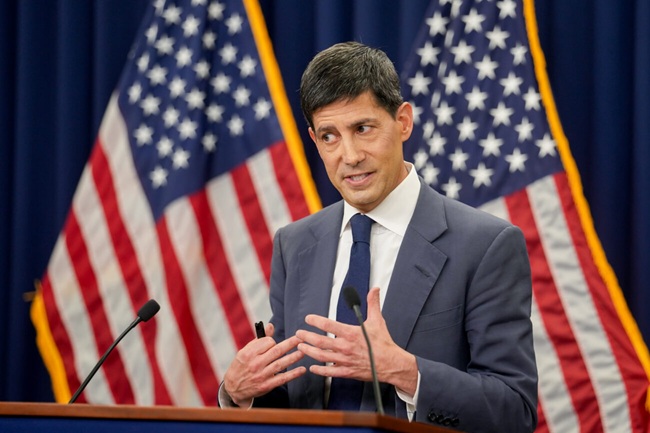
This was Kevin Warsh’s first meeting as chair. He walked in and immediately started rebuilding the machine. That is the story.
The statement got gutted, and the cuts are gone
Start with the document itself, because the redaction tells you more than the words that survived. The April statement ran long in the usual way, full of the boilerplate the Fed has leaned on for years. It promised to carefully assess incoming data and the balance of risks, it reaffirmed a commitment to returning inflation to 2 percent, and it carried the language a careful reader treats as the easing tell, the bit about the extent and timing of additional adjustments.
The June statement throws nearly all of that overboard. What is left is three short paragraphs. Rates held, ample reserves reaffirmed, activity solid despite Middle East uncertainty, inflation still elevated in part because of supply shocks in energy, and then a flat declarative sentence: the Committee will deliver price stability. No forward guidance. No balance of risks paragraph. No data-dependence litany.
Two things matter here. First, the easing bias is structurally gone, not softened. You do not lose that language by accident. Second, and this is the part I want to sit with, the statement explicitly names supply shocks as a driver of the inflation it is staring at. That phrasing is straight out of the framework we have been building on the site. The honest read of the current inflation is that a meaningful chunk of it is a supply-side energy shock layered on top of an already elevated price level, not fresh demand-pull pressure. The Fed wrote that down. And then, as we will see in the dots, it leaned hawkish into it anyway. Hold that contradiction, because it is the whole ballgame.
The dot plot did the talking Warsh wouldn’t
Warsh refused to submit a dot. He said plainly that for him the projection is not helpful, which is consistent with what he has signaled for years about the SEP as currently built. So the chair removed himself from the single most market-moving artifact the Fed produces, and then let the rest of the committee speak through it.
What they said was hawkish. The median end-2026 funds rate moved up to 3.8 percent, from 3.4 percent back in March. That is not a rounding error. In March the median pointed to cuts on the year. Today it points to a hike, with the cut pushed out into 2027. The internal split was roughly nine for a hike, eight for a hold, one lonely cut. The inflation projections were marked up hard at the same time, with headline PCE now seen at 3.6 percent for 2026 against 2.7 percent in March, and core around 3.3. Growth held up at 2.2 percent, unemployment near 4.3.
So the committee simultaneously said inflation is partly a supply shock and penciled in a rate hike to deal with it. That is the policy-error setup we have talked through before. You do not fix a supply-side energy spike by tightening into it. Higher rates do nothing to bring more oil out of the ground, they just compress demand elsewhere in the economy to make room for the energy bill. The market clearly read the hawkish dots as the binding signal, because by the close the futures were pricing better than a 90 percent chance of a hike by October.
The market may have sold the uncertainty, not just the dots
There is a reading of today’s selloff that the hawkish dots alone don’t fully support, and it has more to do with how Warsh talked than what the committee penciled.
If this were purely a hawkish-dots story, you’d expect a clean, mechanical repricing. Rates up, rate-sensitive sectors down, move on. That is not quite what happened. Stocks wobbled through his remarks and then extended losses into the close. The dollar had its best day in almost a year. The 2-year jumped 16 basis points. That combination is not just “higher rates are bad for stocks.” It is a market widening the distribution of outcomes. When you cannot pin down the reaction function, you don’t simply lower your price target, you fatten the tails, and fatter tails mean you pay less for risk and bid up the dollar and the front end. The size of the dollar move in particular looks like an uncertainty premium, not a tidy rate-differential trade.
And the uncertainty was deliberate. Powell over-explained. He would walk you through the reaction function until you could almost trade it yourself, and the market came to lean on that handholding. Warsh did the opposite on purpose. He killed forward guidance, hinted at fewer press conferences, and when reporters pressed him he said he had nothing more to add beyond the statement and described his own answers as curt. He has argued for years that markets work best when they react to incoming data rather than guessing how the Fed will respond. So the vagueness is not him being green or evasive. It is the thesis in motion. He is trying to strip out the Fed’s role as the interpreter of information and force the market to price the data itself.
The catch, and this is the tradeable part, is that you cannot flip that switch cleanly. A market trained for a decade to lean on forward guidance does not transition to self-reliance in a single afternoon. Take the crutch away mid-stride and the first thing that happens is a stumble. The initial repricing of a less-legible Fed is almost always wider risk premia, because valuations have to back out the guidance that was baked into them. So the selloff is plausibly three things stacked on top of each other: the hawkish dots, a higher discount rate for a genuinely less predictable Fed, and a one-time adjustment cost for the regime change itself.
I can’t cleanly separate how much of the move was each, and I’d distrust anyone who claims they can. The tape does not decompose that neatly. But the dots alone leave money on the table as an explanation, and the more complete read is that Warsh is willing to eat near-term volatility as the price of resetting how the Fed communicates. He thinks a market that prices data instead of guidance is healthier over the long run. Whether you call that bravery or arrogance depends on your priors, and you don’t have to settle it to see that the transition carries a cost and the market just paid the first installment. It also tells you the communications task force is not academic. It is the formalization of what he just did live at the podium.
Warsh’s AI thesis just collided with his own rate path
There is a deeper contradiction buried in this meeting, and it sits inside Warsh’s own stated worldview. The case he built for himself as a rate-cutter, going back to his November op-ed, rested on AI as a disinflationary force. More productivity, more output without more inflation, American competitiveness, and therefore room to cut. That is the through-line of how he thinks, and his new productivity-and-jobs task force, explicitly built around AI as a general-purpose technology, tells you he still believes it.
The problem is sequencing, and it is a chicken-and-egg problem he cannot wave away. The disinflation he is counting on is downstream of a buildout that has not finished. You do not get the productivity payoff until the data centers, the compute, and the power are actually in the ground and running. The boom is the input, not the result. And the boom is the capital-intensive phase, happening right now, before any of the disinflation he is banking on can show up. So when he signals higher-for-longer while the thing is still being built, he is raising the cost of the input his entire thesis depends on. He is trying to harvest the crop while making the seed more expensive to plant.
A year ago there was a clean rebuttal to this, and it went like the Apollo line: the hyperscaler buildout is rate-insensitive, the giants fund it out of cash flow and fear of missing out, so what the Fed does barely matters. That rebuttal is now out of date, and the financing data is what kills it. Capex has outrun the cash flow that used to cover it. Alphabet alone guided 2026 capex to roughly 175 to 185 billion against trailing free cash flow near 73 billion, which by their own arithmetic forces them into external funding for the gap. The five largest hyperscalers have pulled more than 137 billion out of the capital markets since late 2024, and total issuance for the group is tracking toward 230 to 240 billion this year. Oracle is already free-cash-flow negative, running a 45 to 50 billion financing plan split between debt and equity, sitting two rungs above junk. Bond investors have said out loud that the old unspoken contract, the one where AI capex stayed equity- and cash-funded and away from the debt markets, has broken. The buildout has crossed from self-financed to market-financed. (read more on this here)
That crossing is what turns Warsh’s contradiction from a debating point into a mechanical one. The moment the buildout depends on the capital markets is the exact moment the cost of capital starts to gate the pace of construction. Higher-for-longer, with the 10-year pushing 4.5 percent, is not a neutral backdrop for that. It is a tax on the very buildout whose completion is the precondition for the disinflation he wants to use to justify cutting. He cannot pull the productivity dividend forward out of a future his own rate path is pushing further away.
And it lands unevenly, which makes it worse rather than better. The fortress names can still largely absorb it. The pressure falls on the tier below, the developers, the neoclouds, the power and grid financing, and increasingly on the off-balance-sheet structures, the SPVs and private-credit joint ventures where a growing share of this debt is migrating. That financing is more spread-sensitive and more rate-sensitive than a Microsoft bond, and it happens to be the connective tissue a buildout this size cannot do without. So the policy error, if it is one, does not hit the headline names that dominate the index. It hits the marginal builder holding the part of the supply chain with the least margin for error. Warsh is betting on an AI productivity miracle to bail out his inflation problem, while setting a rate path that makes the miracle more expensive to build, for everyone except the handful of players who needed his help least.
The real meeting was the five task forces
Here is where I think most of the coverage is going to underweight what actually happened, and where the plumbing lens earns its keep.
Warsh announced five task forces, each aimed at a load-bearing piece of how the Fed operates. Communications. Balance sheet policy. Data sources. Productivity and jobs in an AI era. And the inflation framework itself. He said work begins within a couple of weeks, and that he is pulling in people from outside the usual economics priesthood.
The one to circle is the balance sheet task force. Warsh said explicitly it will review the benefits and risks of the current ample reserves regime and the composition of the balance sheet, and assess alternative frameworks for the conduct and operation of monetary policy. Read that slowly. The ample reserves regime is the post-2008 architecture, the floor system where the Fed pays interest on a mountain of reserves to set rates. Putting that on the table for review is not housekeeping. It is the door to exactly the kind of plumbing-level accommodation we have been watching for, the stuff that does not show up as a rate cut but loosens conditions all the same. SLR relief, reserve management, the mechanics of how the balance sheet is run off or held. None of it requires moving the funds rate a single basis point.
This is the tell I have been describing. If you are a chair who believes, as Warsh said today, that markets work best when they react to data rather than guessing how the Fed will react, and who has openly wanted regime change at the institution, you do not deliver accommodation through a loud rate cut that picks a fight with your own inflation language. You deliver it quietly, through the plumbing, while the statement stays hawkish and the dots show a hike. The rate path and the liquidity path can point in opposite directions. That gap is the opportunity and the risk.
He also confirmed the SEP itself is going under the communications task force’s knife, with changes expected. The chair who won’t submit a dot is now in a position to reshape or retire the dot plot. That is worth tracking, because if forward guidance is dead and the SEP gets neutered, the Fed’s reaction function becomes genuinely harder to front-run, which is, I suspect, precisely the point.
What this changes for how I’m positioned
A few practical notes, in the spirit of practitioner and not pundit.
The debasement thesis is untouched by a hawkish print, and arguably strengthened by the contradiction at the center of this meeting. A Fed that names a supply shock and then signals a hike is a Fed boxing itself into a corner. The debt-service convexity argument has not gone anywhere either. Every basis point of additional hiking lands on a Treasury income statement that gets more sensitive as low-coupon paper rolls off into the current rate environment. The committee can pencil 3.8 percent. Whether the fiscal arithmetic lets them actually sit there for long is a separate question, and it is the question I care about more than the dot.
Gold’s reaction will be the cleaner read than the knee-jerk. The instinct is that hawkish dots and a jump in the 10-year toward 4.5 percent are a headwind for metal, and on the day that is how it trades. The longer arc is the balance sheet review. If the plumbing turns accommodative while the rate stays nominally restrictive, that is the debasement-friendly regime hiding underneath a hawkish costume. I am not adding aggressively into the immediate reaction. I am watching the unwind, the same way I watched the war-premium unwind, and looking for the spot where the mean reversion overshoots and hands you a re-entry.
And the behavioral note for myself, since this is the kind of tape that triggers it. A sharp hawkish repricing into the close is precisely when I am tempted to either sit too defensively and miss the snapback, or chase the move once the hawkish narrative becomes consensus tomorrow morning. The structure is built to handle this. No new buys after the close. The covered calls keep doing their job. Let the open price the news, and react to data, which, ironically, is exactly what the new chair just told everyone to do.
The one line to remember
The Fed wrote down that part of this inflation is a supply shock, then showed you a hike anyway, and buried the real accommodation lever inside a balance sheet task force nobody on television will lead with. The rate decision was the decoy. The plumbing is the policy. Watch the pipes.
