


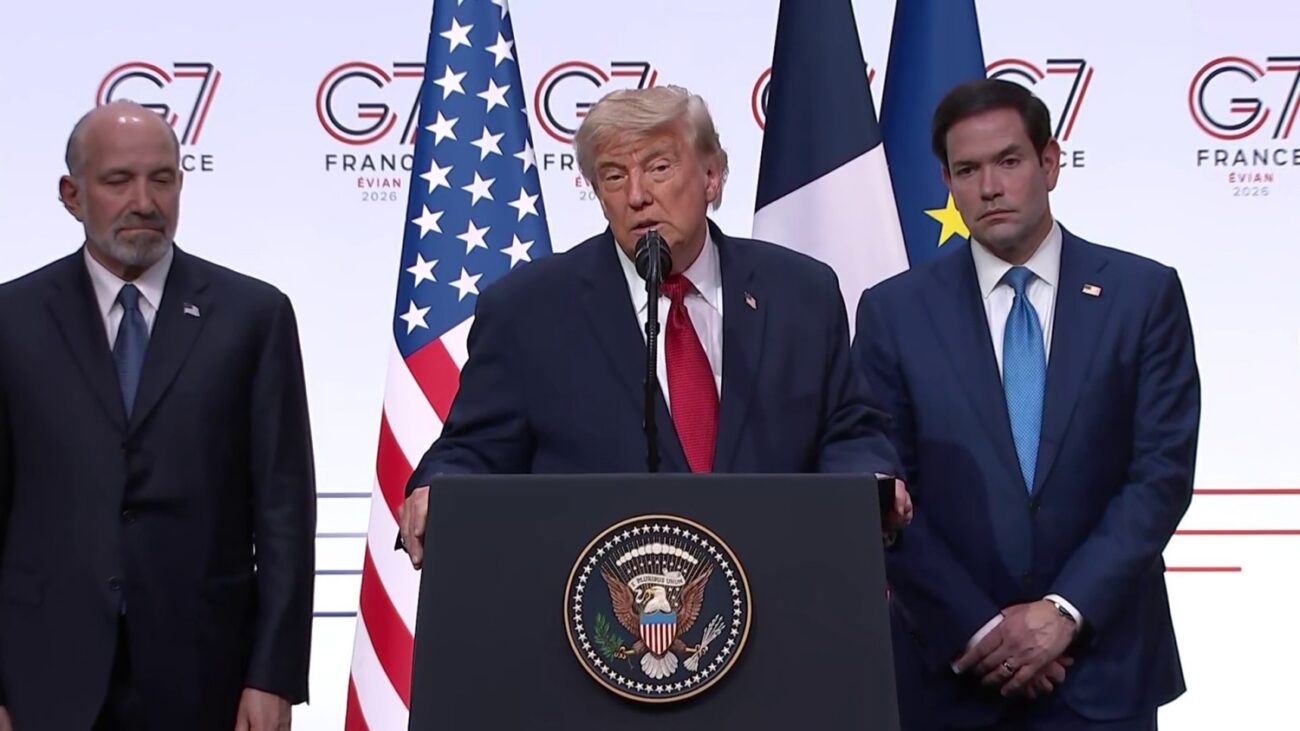
The war premium is coming out of crude, and it is coming out fast. That is the trade hiding inside a day that otherwise looked like diplomatic theater. The G7 wrapped in France, Trump took his victory lap, and underneath the photo ops the actual market event was oil retracing months of fear in a matter of sessions. Here is what happened and what I think it means for the cross-asset picture.
What was actually signed
Trump signed the 14-point memorandum of understanding with Iran today, on his way out of Versailles, and a US official says the agreement is now in effect. That moved faster than the earlier plan, which had the operative signing waiting until a Friday ceremony in Switzerland. That ceremony still happens, but it is now the ceremonial version of a deal that is already live. Iranian state TV released text that largely matches what US officials read to reporters, so the broad terms are no longer in dispute even though a clean official written copy from the US side trailed the announcement.
The terms matter for the oil read because they are specific. The Treasury issues waivers for the export of Iranian crude, petroleum products, and the associated banking, insurance, and transport, immediately upon signing. Frozen Iranian assets get unfrozen. There is a framework for at least 300 billion dollars in reconstruction, with Trump saying the US itself will not contribute but cannot stop other countries from investing. The agreement asserts Iran will not build a nuclear weapon, and commits both sides to address the existing enriched stockpile through down-blending on site under IAEA supervision. The two sides then have 60 days to negotiate a final deal.
A caveat worth stating plainly: the nuclear commitment is not new. Iran has pledged not to build a weapon many times over the decades. Administration officials are framing the down-blending concession as a floor for further talks rather than a ceiling, which is the optimistic read. The skeptical read is that a 60-day negotiating window with the hard questions deferred is a ceasefire with a nuclear annex, not a resolution. Either way, the market does not need the nuclear question settled to reprice oil. It just needs the strait open and the barrels flowing, and as we will see, those are two different things.
The keystone is Hormuz, and the timeline is the story
The market piece of this is the Strait of Hormuz, which Iran has effectively controlled since the war began on February 28, choking a passage that carries something like a fifth of the world’s oil. Here is where the actual MOU text changes the picture versus the breathless headline version.
The US lifts its naval blockade immediately, but fully ends it within 30 days. Commercial shipping through Hormuz restores to prewar levels within 30 days of signing, and that restoration is explicitly conditioned on Iran clearing technical and military obstacles and demining the waterway. So even with the deal in effect as of today, the document itself codifies a multi-week physical timeline, with mine clearance as a gating step. And it may run longer than the text implies: foreign-policy analysts are saying it could take months, not weeks, for oil flow to actually normalize, with scouring the seabed for mines alone likely taking weeks. Tonight it was not even clear Iran had begun the steps to reopen the strait, and Trump’s social-media claim that ships “loaded up with Oil” are already moving through a “totally safe, secure, and pristine” waterway should be read as a victory lap, not a shipping report.
That is the single most important nuance in the whole event. The deal is signed and live, but signed and live is not the same as flowing. The market is pricing the expectation of barrels while the text says thirty days and demining first, and the experts say maybe months. There is also a live fight over money at the chokepoint. Iran’s foreign minister has already signaled that while Tehran will not call it a toll, it intends to charge a “service fee” for passage and that its “sword will remain poised over the Strait of Hormuz indefinitely.” US officials counter that tolls will not stick past the 60-day free window because the Gulf states will never accept anything other than toll-free access for their own industries. That is exactly the kind of detail that determines whether “free and open” is durable or temporary. So the reopening is real and now operative, but it is a process with a clock, a minefield, and a fee dispute, not a switch.
The oil move
This is the number to anchor on. Brent fell roughly 4.8 percent to around 83 dollars, WTI down into the low 80s, both at their lowest since the first week of March, which is right about when the war kicked off. So in price terms, crude has essentially round-tripped the entire conflict.
But do not let the round-trip framing fool you into thinking the premium is fully gone. Before the war, oil was fetching closer to 70 dollars. So we have unwound the acute spike, the panic bid, the closed-strait premium, but there is still roughly ten-plus dollars of elevation versus the genuine prewar baseline. The war premium has compressed hard. It has not fully bled out. That distinction is the whole opportunity, because it tells you the move may not be over, and the 30-day physical timeline gives the remaining premium a reason to drain gradually rather than all at once.
Why this matters beyond the oil pit
The reason I am writing this up as more than a crude note is the timing. This oil collapse landed on the same afternoon as the Warsh Fed’s first meeting, and the two events point in opposite directions on inflation.
The Fed’s statement explicitly named energy supply shocks as a driver of the inflation it is fighting, then the committee marked its inflation projections up and penciled in a rate hike. Meanwhile, the actual supply shock they are pointing at is unwinding in real time, right out the window, as the blockade lifts and crude retraces. Even the wire coverage caught it: the falling oil should ease some of the pressure on the new chair. If Brent keeps draining toward that 70 baseline over the 30-day reopening window, the hawkish inflation forecasts the Fed just published start aging badly. That is the tension I find most interesting in the whole setup. The central bank is tightening into a supply shock that is fixing itself on a defined schedule.
There is a clean logic here that gets lost in the noise. You do not cure a supply-driven energy spike with higher interest rates. Rates do not bring oil out of the ground, and they certainly do not clear mines out of the Strait of Hormuz. The thing that cures a supply shock is the supply constraint clearing, which is exactly what the MOU lays out, on a timeline. The market is doing the Fed’s job for it, and the Fed is acting as if it still has to do that job itself.
How I’m reading it
The honest summary is that today was a genuine de-escalation with a real and tradeable disinflationary consequence, wrapped in an agreement that is signed and reportedly in effect but whose hardest questions are deferred to a 60-day negotiation, and whose physical payoff has not actually started. The oil unwind is real. The remaining premium versus the 70 baseline says the move may have further to run, and the document’s own 30-day reopening timeline, plus expert estimates of months to fully normalize flow, tell you it should drain in steps rather than in a single gap. The risk to that view is execution: demining that runs slower than promised, the service-fee fight reasserting friction at the strait, or the MOU fraying during the nuclear talks. Any of those would put a floor under crude faster than the bulls expect.
For now, the cleaner reads are the cross-asset ones. Oil down is doing disinflationary work the Fed is refusing to credit. Gold down is a fear-trade unwind, not a thesis change. And the gap between a supply shock that is healing on a published schedule and a Fed still tightening into it is the thing I will be watching unfold over the next 30 days.
