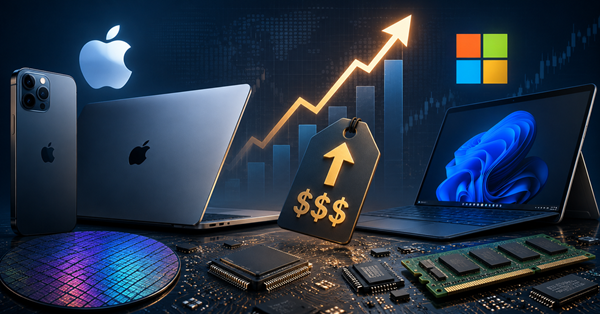
Apple raised prices last Thursday. Not on the iPhone, which it pointedly left alone, but on MacBooks, iPads, the HomePod, Apple TV, and the Vision Pro. Hours later Microsoft followed with a price increase on Xbox consoles set to take effect August 1. Both companies pointed at the same culprit, and they said it plainly. Memory and storage chips have gotten expensive, and they have gotten expensive fast.
The language in Apple’s statement is worth sitting with, because companies of its size do not usually talk this way. It said it had never seen a component price increase this much, this quickly, and that it had reached the point where it could no longer shield customers. Tim Cook had been telegraphing the move for weeks, describing the component situation as unsustainable in interviews ahead of the announcement. Microsoft was just as blunt, noting that console storage and memory prices have more than doubled and that it expects them to double again by the fall of 2027.
The market read it as a problem. Apple closed more than six percent lower on the day of the announcement, its worst session in over a year. That reaction tells you something about how the move was received, but the more interesting question is not what it did to the stock. It is what the move says about where cost pressure in the real economy is building, and whether any of it actually shows up where most people will look for it.
A supply shock with a demand engine
The clean way to file this is cost-push inflation. The product did not change. Apple refreshed nothing on June 25. The same MacBook Air, the same iPad, the same Apple TV running the same chip it has carried for years, all simply got more expensive. When the price of an unchanged good rises because the cost of making it rose, that is about as textbook a supply shock as you will find in consumer technology.
But the textbook label undersells what is happening underneath. A supply shock in the usual sense is something like an oil disruption, where a barrel becomes scarce because something external interrupted the flow. What is squeezing memory here is not a disruption. It is demand. AI data centers are buying DRAM and NAND at a scale that is crowding out the consumer electronics supply chain, and that demand is not a weather event that passes. It is a structural buildout with years left to run.
So the cause is supply-shock in its mechanics and demand-pull in its origin. The shortage is real, but the shortage exists because one enormous buyer decided it needed everything the fabs could produce. The scale of that buyer is the whole story. By one estimate, data centers will absorb roughly seventy percent of all high-end DRAM production this year, and prices for the stuff jumped on the order of eighty to ninety percent in the first quarter alone, a pace one research shop called unprecedented. That distinction matters for anyone trying to guess how long this lasts. A weather-driven shock reverses when the weather clears. A demand-driven shortage reverses only when the demand cools or the supply catches up, and neither looks imminent. Analysts covering the space have suggested component costs may not normalize until 2027 or later, which lines up almost exactly with Microsoft’s own forecast.
Why the CPI print will probably disappoint you
Here is where expectations need managing. The instinct, watching two of the largest companies in the world raise prices on the same day for the same reason, is to assume this lands hard in the next inflation report. It probably will not, at least not in a way that jumps off the page.
Personal computers, tablets, and game consoles are a small slice of the consumer basket. The categories that move a CPI print are shelter, food, energy, and services, and a hundred dollars on a MacBook does not register against those weights. There is also the matter of how electronics get measured. The statistical agencies apply quality adjustments to technology goods, and that machinery tends to absorb part of a price move by reasoning about performance per dollar. A reader expecting these hikes to push the headline number visibly higher next month is likely to come away thinking nothing happened.
That gap, between how big the story feels and how small it reads in the data, is the part worth understanding. The absence of a CPI fingerprint is not evidence that nothing changed. It is evidence that the basket was not built to capture this kind of change quickly.
The signal is the precedent, not the print
The reason this matters has little to do with next month’s number. It has to do with what Apple’s decision reveals about the state of margin absorption across the sector.
Apple is the company best positioned in all of consumer electronics to eat a cost increase. It has the deepest supplier relationships, the most leverage over its component partners, and the fattest margins to absorb a hit without passing it along. For most of this cycle that is exactly what it did. So when the most cushioned player in the industry announces it can no longer hold the line, the useful inference is not about Apple. It is about everyone with less leverage. Analysts made this point directly, noting that rival device makers without Apple’s supplier ties may have to raise prices more sharply, not less.
And the ones with less leverage already moved. Apple was not first. It was late. Sony raised PlayStation 5 prices across the lineup back in March. Valve pushed the Steam Deck OLED up by as much as forty-six percent in May, with one model jumping two hundred dollars in a single revision. Nintendo confirmed a Switch 2 increase weeks before Apple said a word, pointing at the same memory costs and quantifying the hit to its own books in the hundreds of millions. The pass-through has been climbing the leverage ladder for months, starting with the thin-margin hardware makers who had no cushion to begin with and arriving only now at the company most able to wait. That is the tell. When the pressure reaches the player with the most room to absorb it, the absorption phase is not slowing down. It is ending.
That is the mechanism that eventually reaches the data, and it reaches it through breadth rather than through any single product. One company raising prices on a laptop is a line item. A whole category of manufacturers concluding that the absorption phase is over is a different thing, and it builds slowly across many goods rather than arriving in one report. Apple going first, and saying so out loud, is the kind of marker that tends to precede broader pass-through.
Where this meets the rate conversation
Set this next to what came out of the Fed last week and the picture sharpens. The new chair struck a hawkish tone in his first statement, and the market moved to price rate hikes later this year rather than the holds it had assumed. A central bank leaning hawkish into fresh cost-push pressure in goods is a familiar setup, and it is the kind of thing that keeps policy tighter for longer.
What makes this particular episode unusual is the shared root. The cost pressure showing up in consumer hardware and the AI capex boom unsettling the rate outlook are not two stories. They are one. The same data center buildout that has hyperscalers issuing debt and reshaping the equity market is the thing draining the memory supply that Apple and Microsoft just stopped absorbing. The hikes and the hawkishness grow from the same tree.
None of this points to a trade. It points to a way of reading the next several months. When you see goods inflation surprise to the upside in pockets, or device makers further down the food chain raise prices through the back half of the year, the explanation will already be on the record. It started with the one company that could afford to wait the longest deciding it could not wait any longer.