


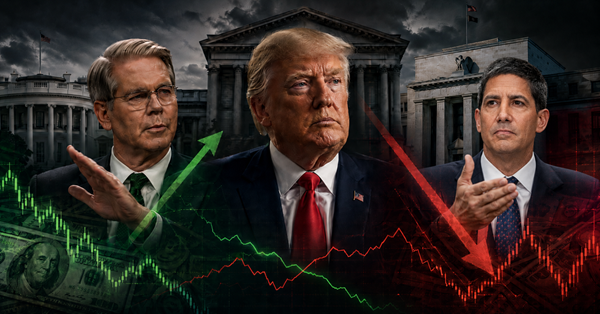
Anyone watching the financial press this week could be forgiven for thinking the people running American economic policy have stopped talking to each other. The President went on television wanting interest rates lower and then refused to put his signature on a bipartisan housing bill. The new Fed chair has spent his first weeks in the job sounding tougher on inflation than the man he replaced, with rate hikes suddenly back on the table. The Treasury Secretary went on CNBC and spent his airtime defending the strength of the dollar. Three men, three messages, and on the surface they appear to be pulling in three different directions at once.
The confusion is understandable, but it dissolves once you stop treating these as three competing opinions about the same question. They are not. Each man is answering a different question, from a different chair, with a different job to protect. When you sort the statements by who said them and why, the noise resolves into something closer to a coordinated division of labor than a family argument.
The President wants the price, not the mechanism
Start with Trump, because his is the loudest voice and the one most prone to being read literally. He told reporters that higher interest rates keep the country down, a line consistent with everything he has said about borrowing costs for years. He wants rates lower. That much has never been in doubt.
What is different now is what he is doing about it, which is almost nothing. The same President who spent the better part of last year publicly attacking Jerome Powell, floating lawsuits, and attempting to remove a Fed governor has spent his first weeks with Warsh in the chair saying things like he wants Kevin to be totally independent and that he is guided by what Warsh wants. When the Fed held rates steady and signaled a possible hike, there was no Truth Social tirade aimed at the building. The contrast with the Powell era is the entire point. Trump appears to have decided that with his own appointee running the institution, he can want lower rates rhetorically while granting the chair the room to deliver them on his own timeline.
The housing bill is a separate matter entirely, and conflating it with rate policy is where a lot of the week’s confusion comes from. Trump canceled the signing ceremony for the bipartisan housing package not because he opposes its contents, which the White House supported, but because he is using it as leverage to force a vote on a voter identification bill he has been pushing for months. It is a procedural hostage situation, not a statement about the cost of credit. The housing bill passed both chambers with margins large enough to override a veto, so the practical effect on housing affordability may end up being limited regardless. The signal it sends is about how the President negotiates with his own party, not about where he thinks mortgage rates should go.
The Fed chair is defending the institution, not the President
Warsh is the figure whose tone has shifted most visibly, and that shift is the source of much of the apparent contradiction. He was appointed by a President who wants lower rates, and yet he has come out of the gate talking tough on inflation, declining to offer forward guidance, and presiding over a meeting that dropped the bias toward future cuts and floated a hike. To a casual observer this looks like the appointee defying the man who appointed him.
It is better understood as Warsh establishing that he is not a pushover, which is a more valuable thing to Trump in the long run than an immediate cut would be. The credibility of a central bank rests almost entirely on the market’s belief that it will do what is necessary on inflation regardless of political pressure. Powell guarded that credibility with the studied neutrality of a man who would not even wear a colored necktie. Warsh is guarding the same asset through a different posture, by sounding hawkish enough early on that nobody can accuse him of being installed to print easy money for the White House. The distinction he keeps drawing is the one that matters most here. He has said repeatedly that what he cares about is the underlying rate of inflation, not one-time price changes from a geopolitical event like the Iran energy shock. In central banking that approach is called looking through a supply shock, and it is the intellectual bridge that lets the same person be hawkish in tone now and open to cutting later. If the war-driven spike in energy prices fades and underlying inflation comes back toward target, the hawk can become a dove without ever having contradicted himself, because the thing he said he was watching will have changed.
That is the key to the whole puzzle. Warsh has built himself a framework in which holding firm today and cutting tomorrow are the same consistent policy, contingent on the data rather than on anyone’s preferences.
The Treasury Secretary is selling the dollar to the world
Then there is Bessent, whose job is the one most often misunderstood by people watching from a markets desk. The Treasury Secretary does not set interest rates and does not control inflation. His mandate, the one he has held since the beginning of the administration, is the dollar and the country’s standing as the center of the global financial system. So when he goes on CNBC and talks about dollar dominance being essential, about sanctioned economies being pulled back into dollar invoicing, and about who gets to write the rules for digital assets and stablecoins, he is not commenting on the Fed’s next move. He is doing his actual job, which is keeping global capital flowing toward American markets.
The piece of his message that looks like a contradiction is his argument that you can have a strong dollar even while the Fed cuts rates. On its face that sounds like wishful thinking, since lower rates usually mean a weaker currency as yield-seeking money flows elsewhere. But Bessent’s claim rests on a specific condition. If the Fed is cutting because inflation is genuinely falling while the economy stays strong, then capital keeps coming in for reasons that have nothing to do with the rate differential. Growth, productivity, and stability do the work that high rates would otherwise do. He leaned heavily on artificial intelligence as the engine of that productivity, citing the scale of spending by the large technology companies and suggesting it could meaningfully lift output the way the buildout of the late 1990s did. Whether that thesis proves correct is a separate question. The point for now is that it is internally coherent and it is aimed at a foreign audience deciding where to park its money, not at a domestic audience wondering about their mortgage.
The thread that ties them together
Once the three are sorted by role, a single story emerges underneath them. All three men are betting on the same sequence of events. They are betting that the Iran shock was a temporary spike rather than the start of a lasting inflation problem, that energy prices will keep falling now that the conflict has eased, that underlying inflation will drift back toward the Fed’s target over the rest of the year, and that the economy stays strong enough to keep foreign capital flowing. Trump’s willingness to grant Warsh room, Warsh’s framework for looking through the shock, and Bessent’s case for a strong dollar through rate cuts are three different expressions of the same underlying forecast.
That is what makes the messaging feel contradictory when it is actually complementary. Each man is emphasizing the part of the shared bet that falls within his job. The President owns the politics and the pressure. The Fed chair owns the institutional credibility and the inflation mandate. The Treasury Secretary owns the dollar and the country’s place in global finance. They are not arguing. They are dividing the labor of selling the same outcome to three different audiences.
The risk in the whole arrangement sits in the one assumption all three are leaning on, which is that inflation behaves the way they expect. The bond market is not fully convinced. Traders have pushed up the odds of a rate hike this year and driven short-term yields to their highest in more than a year, which is precisely why the dollar has surged through chart resistance toward its strongest monthly gain in nearly a year. The market is betting Warsh may have to back his tough talk with an actual hike rather than the cut the President would prefer. The upcoming reading on the Fed’s preferred inflation gauge becomes the next real test of whose forecast is closer to right.
If the data cooperates, the three voices will look in hindsight like a well-rehearsed chorus. If it does not, the division of labor becomes a division of opinion in a hurry, and the room Trump has granted Warsh gets a great deal smaller. For now, the apparent contradiction is mostly a function of listening to three men do three different jobs and expecting them to sound like one.
