The peptide story has been one of the quieter momentum trades of 2026, riding a simple thesis: the FDA, under a Health and Human Services secretary who has personally championed these compounds, was going to open the door to a whole new category of compoundable therapies. Today that thesis took its first real hit, and it came from inside the building.
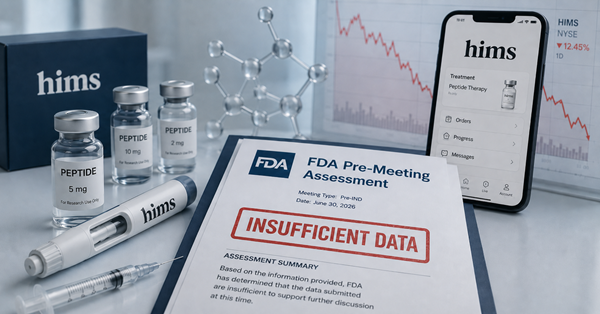
FDA scientists released their assessment ahead of the agency’s own advisory committee meeting, and the conclusion was blunt. There is insufficient evidence to recommend the use of the seven peptides up for review. Some of them, the reviewers noted, have not even been studied in humans. This is the agency’s technical staff putting a marker down before the Pharmacy Compounding Advisory Committee convenes on July 23 and 24 to vote on whether these substances should be eligible for compounding under section 503A.
It is worth being precise about what happened and what did not, because the headlines will blur the two. This is not a rejection. It is not a ban. The committee has not voted, and the FDA has not issued a final decision. What happened is that the scientific staff, whose job is to evaluate safety and efficacy data, looked at the evidence base for compounds like BPC-157, TB-500, KPV, MOTS-C, and the others on the July agenda, and concluded the data is not there. That matters because the advisory committee process has a well established pattern. The panel usually leans on the reviewers’ analysis, and the agency historically almost always accepts the advice of the committee. When the staff assessment is skeptical, the base rate for a favorable outcome drops considerably.
That is the setup investors need to understand. The peptide trade was priced for a green light. Today’s disclosure raises the odds of a red one, or at least a much more grudging yellow, and it does so about three weeks before the vote that actually decides it.
The clearest place this lands is Hims and Hers. The stock has been the market’s primary vehicle for expressing the peptide thesis. It ran more than twenty five percent across two sessions back in April when the reclassification news first broke, and it has spent the months since building peptides into its forward growth narrative. The company acquired a peptide manufacturing facility, its chief medical officer publicly applauded the move away from what he called the gray market, and the more aggressive sell side estimates floated peptide revenue in the billions by the end of the decade if the company could capture even a low single digit share of the market. That is a large number resting on a regulatory outcome that just got less certain.
Here is the important framing for anyone holding or watching the name. The peptide opportunity for Hims was always a call option layered on top of the core business, not the core business itself. Even the analysts most enthusiastic about the long term peptide potential were consistent that it would not translate into near term revenue and that investor focus should stay on the GLP-1 franchise. Leerink, for one, kept a Market Perform rating and a price target well below where the stock has been trading, precisely because it separated the exciting story from the actual cash flows. The Novo Nordisk partnership, the international expansion through the Eucalyptus and ZAVA acquisitions, and the trajectory of the weight loss business are what pay the bills today. Peptides were the upside scenario for 2027 and beyond.
So the way to read today is as a repricing of the option, not a collapse of the business. If the market had assigned meaningful probability to a clean peptide clearance, and the run up suggests it had assigned some, then a skeptical staff review should compress that probability and take some air out of the stock. What it should not do is change the thesis on the parts of Hims that are actually generating revenue right now. The discipline here is separating the two. A trader who bought Hims purely for the peptide catalyst is holding a very different position after today than one who bought it for the GLP-1 platform and treated peptides as a free lottery ticket.
The broader lesson extends past any single ticker. When a trade is built on a regulatory catalyst, the catalyst is the entire position, and regulatory processes have intermediate signals that arrive before the final decision. A staff assessment, an advisory committee agenda, the tenor of the questions at the hearing, all of these are information that moves the odds well before the vote is gaveled. The market spent months pricing the optimistic end of this range on the strength of political support at the top of HHS. Today was a reminder that the scientists still get to write their assessment, and that the gap between a policy preference and a regulatory clearance is exactly where these trades live or die.
The vote is still coming on July 23 and 24. Nothing is settled. But the probability distribution shifted today, and for a trade that was leaning hard on a favorable ruling, a shift in the distribution is the whole game.