


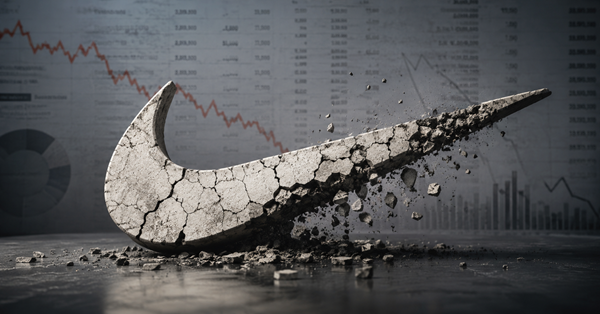
Nike closed the book on fiscal 2026 with a number that looked, at first glance, like a genuine turning point. Reported earnings of seventy two cents per share against a Wall Street consensus sitting near twelve to thirteen cents is the kind of print that gets flagged as a blowout before anyone reads past the top line. The stock briefly traded up more than two percent in the after hours session on that first impression. Then the market did the reading, and the reaction inverted. Shares fell as much as eight percent before recovering, settling down around three and a half percent near the forty dollar handle. The story of why that happened is worth walking through carefully, because it is a clean example of how a single accounting line can distort the read on an entire quarter.
The seventy two cent figure was real, but it was not operational. Roughly fifty two cents of it came from an expected recovery of tariffs Nike had previously paid, tied to the IEEPA duties that the Supreme Court struck down. The company now expects to recover close to nine hundred eighty six million dollars in refunds, and it booked the benefit into this quarter’s results. Strip that one time item out and the underlying number lands at twenty cents per share. That is the figure that matters for anyone trying to understand how the business actually performed, and it is the figure the market ultimately traded on.
Here is the part that gets lost in the disappointment. Twenty cents was still a beat. Consensus was near twelve or thirteen cents, so even the clean number came in comfortably ahead of expectations. The problem was never that the quarter was bad relative to the bar. The problem was that expectations had been set so low, and the guidance attached to the report gave investors little reason to believe the low bar was about to lift.
The gross margin line tells the same story in miniature. Reported gross margin expanded eight hundred ninety basis points to 49.2 percent, an enormous jump that would signal real pricing recovery if it were organic. It was not. That expansion was carried almost entirely by the same tariff benefit. Back it out and gross margin was 40.2 percent, down ten basis points year over year. So the two figures that made the quarter look transformative, the earnings beat and the margin surge, were both products of the same refund. That is not a criticism of Nike’s accounting. The refund is legitimate and the cash is real, with management noting they had already collected over three hundred million dollars of it by quarter end. It is simply a reminder that a beat driven by a nonrecurring item does not carry forward into next quarter.
Underneath the accounting, the operating picture was mixed in a way that matches Nike’s own framing of a turnaround that will not move in a straight line. Revenue came in at just under eleven billion dollars, down one percent on a reported basis and down four percent currency neutral, which still edged past the ten point eight six billion consensus. North America, the largest market, grew three percent to 4.83 billion, though that actually fell a touch short of what the sell side had modeled for the region. Running and football and the broader performance categories continued to grow. Those are the areas CEO Elliott Hill has pointed to as the early proof that the repositioning is working, and they are behaving the way the plan says they should.
Then there is China, which remains the open wound. Greater China revenue fell seventeen percent in the quarter, part of a deliberate reset in which Nike is intentionally reducing sell in and cleaning up an oversupplied marketplace. Management has been consistent that this is self inflicted and temporary, framing it as necessary short term pain to restore the health of the channel. Consistent or not, a seventeen percent decline in a market that was supposed to be a growth engine is the kind of number that keeps investors cautious no matter how it is explained. Nike Direct, the company’s own digital and retail channel, fell nine percent in the quarter, another sign that the direct to consumer push that defined the prior strategy is still unwinding.
The guidance is where the after hours enthusiasm went to die. Management signaled that revenue could decline low to mid single digits over the coming period and described earnings as flattish through the first two quarters of fiscal 2027. Gross margin for the first fiscal quarter of 2027 is expected to be only slightly positive. CFO Matthew Friend has flagged the second quarter of fiscal 2027 as the last quarter of material tariff headwinds, which means the drag investors have been waiting to clear is still a couple of quarters out. For a stock trading near a fifty two week low, well below its two hundred day moving average, a guide that essentially says the inflection is real but not yet is a difficult thing to rally on.
So what does a practitioner actually take away from this. The clean earnings number beat, the operational categories management wants you to watch are growing, and the balance sheet just picked up close to a billion dollars in recovered cash. Those are not nothing. But the two most flattering numbers in the release were illusions of a refund, China is still contracting by design, the direct channel is still shrinking, and the guidance pushes the real margin recovery into the back half of fiscal 2027. This was a quarter that confirmed the turnaround is proceeding roughly on the timeline management laid out, without offering any evidence that the timeline is accelerating. The market priced exactly that. A stock that opened the door to a rally on a fake beat and then closed it on a real guide.
The broader lesson travels well beyond one sneaker company. When a headline print blows past estimates, the first question is never how big the beat was. It is what drove it. A beat built on operations compounds. A beat built on a one time recovery is a single event that flatters one quarter and vanishes from the next. Reading the difference is the entire job.
