


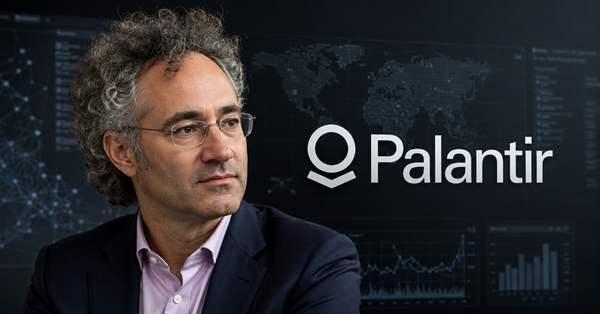
If you only caught the soundbites from Alex Karp’s CNBC hit on Wednesday, you would be forgiven for thinking the Palantir CEO had just called the top on the whole AI trade. The models have been “completely, irresponsibly, oversold.” Something has “gone completely wrong.” Enterprises are livid. Call any CEO in private and they will tell you they are twice as livid as he is. Delivered across a rambling, roughly twenty-minute segment that several outlets openly described as a meltdown, with the hosts repeatedly trying to steer him back on track, it landed for a lot of people as a bubble warning from inside the tent.
It was not. And the gap between what he actually argued, why he argued it, and how the market is reading it is the part worth your time.
Start with the target. Karp was not indicting artificial intelligence, the capex cycle, or the AI trade in general. His fire was aimed at exactly two companies and one pricing model. He named OpenAI and Anthropic, and he went after the token-based billing structure they and the other frontier labs use, the arrangement where you pay per unit of information the model processes. He built a whole coinage around it, tokenmaxxing, meaning enterprises burning cash on per-token consumption while chasing impressive demos without any return on investment to show for it. That is a narrow, specific complaint about how a competitor charges. It is not a claim that the technology is fake or the spending is doomed.
Now the part that reframes everything, and the part the breathless coverage mostly skipped. Two days before this interview, on June 29, Palantir and Nvidia announced a Sovereign AI Operating System. It runs open-weight Nvidia Nemotron models on air-gapped Blackwell hardware and lets customers own their model weights and their training data on their own infrastructure, rather than renting access to someone else’s hosted model by the token. So when Karp tells a national audience that the token model is broken and rational enterprises are fleeing toward open-weight systems they can own, he is not offering neutral market commentary. He is narrating the exact value proposition of a product he started selling forty-eight hours earlier. His sharpest specific allegation, that using the closed labs puts your intellectual property at risk, is his own characterization. It has not been independently corroborated by the labs or documented anywhere in the reporting. Read it as one vendor’s pitch, not as a verified fact about the industry.
This is the oldest move in enterprise software. When a challenger cannot win on the incumbent’s terms, it redraws the terms. The closed-API-versus-open-weight fight Karp is picking mirrors decades of prior platform wars, and the framing always favors whoever is selling the alternative. None of that makes him wrong about token costs. Inference has genuinely gotten more expensive as new models arrive priced above their predecessors, and CFOs are genuinely starting to ask what they got for the bill. But a real cost dynamic that a competitor happens to be monetizing is still a competitor monetizing it. You weigh the substance and the sales motive separately, and here they are pointing the same direction because that is the entire design.
Which is why the “bearish for the AI trade” read gets the sign wrong. If you actually follow Karp’s logic to its conclusion, it is not stop spending on AI. It is stop renting tokens and start owning compute. That is bullish for the hardware layer, most obviously Nvidia, his announced partner, and bullish for self-hosted and open-weight deployment. It is a rotation-within-AI thesis dressed up in bubble-warning language. The money does not leave the sector in Karp’s world. It moves from the frontier labs’ income statements toward the infrastructure and platform layer where, conveniently, Palantir and Nvidia have just planted a flag.
So where does the “he sounded bearish” impression come from? Two places. One is the tone. A twenty-minute stream-of-consciousness that visibly rattled the hosts reads as alarm regardless of content, and alarm gets clipped and shared faster than nuance. The other is that one line, “irresponsibly oversold,” which is a genuinely bearish-sounding phrase detached from the sentence it lived in. Put the tone and the soundbite together and you get a market half-convinced a major AI figure just rang the bell, when what he actually did was run a product launch through a hostile pricing critique.
The practitioner takeaway is not a directional call on Palantir or the labs. It is a reminder about how to read a CEO on television. When a vendor’s diagnosis of an industry problem maps perfectly onto the cure he is selling, the diagnosis is marketing until proven otherwise. That does not mean he is lying. It means the burden of proof sits with the incentive, and the incentive here is not subtle. The real story this week was a June 29 product announcement. Wednesday’s fireworks were the ad campaign, and the market mistook the ad for a warning.
