


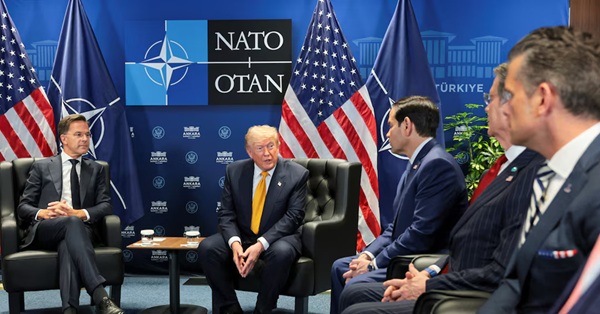
The wires lit up before the U.S. open this morning with the kind of headline that looks tailor made to send everything into a hole. Overnight the United States and Iran traded strikes again, with U.S. Central Command hitting more than eighty targets across southern Iran in response to Iranian attacks on three commercial tankers moving through the Strait of Hormuz. Iran answered with strikes aimed at American bases in Bahrain and Kuwait. Speaking alongside NATO Secretary General Mark Rutte in Ankara, President Trump declared the interim agreement to end the war “over,” said he was done dealing with Tehran, and called the Iranians “scum,” even as he allowed that negotiators could keep talking because in his view it was a waste of time anyway. The Treasury had already moved to revoke the waiver that let Iran sell crude openly on the world market, which Tehran’s foreign ministry called a breach of the June framework.
That is a lot of smoke. The job here is to look at what is actually burning.
The tape is not panicking
Start with oil, because oil is the whole story when Hormuz is involved. Brent pushed higher on the news, with prints ranging from roughly two percent on the early Reuters tape to as much as six percent in European hours, putting it somewhere in the $76 to $78 neighborhood. That is a real move and worth respecting. It is also a long way from the $120 spike we saw when the strait actually closed back in March. The market is pricing a flare up, not a shutdown. One strategist on the wires put it plainly, noting that the market clearly dislikes the attacks but that this is not full blown panic mode. When the worst case is a closed chokepoint and price sits forty dollars below the last time that happened, the tape is telling you it does not believe the worst case today.
The more interesting signal is in bonds. Ten year Treasury yields climbed for a seventh straight session to a one month high near 4.56 percent, with German and Italian yields hitting their own one month highs. Higher oil is an inflation input, and after months of on and off conflict global crude inventories are already drawn down, with U.S. Strategic Petroleum Reserve stocks reportedly at their lowest since 1983. So the bond market is not treating this as a risk off flight to safety. It is treating it as an inflation problem, which is exactly the read that matters if you care where rates go from here. That is the debt service convexity story playing out in real time. A government this levered cannot casually welcome a fresh inflation impulse, and the long end is the place that argument gets settled.
Stocks have their own problem
It would be easy to hang this morning’s equity softness on the Middle East, but that is not quite where the weight is coming from. The Nasdaq was down around a percent, and the reporting pins most of that on the AI rally running short on buyers rather than on the strikes. The tell is in the names. If this were a genuine geopolitical risk off session, you would not see Nvidia and Meta trading green while the index leaks. What you are actually watching is a momentum trade that has gotten crowded looking for any excuse to take a breather, and a Middle East headline is a convenient one. Separating the geopolitical move from the positioning move is the whole game on a morning like this, and here the positioning move is doing more of the work.
The Spain wrinkle
There is a second headline running underneath the Iran story that deserves its own line. From the same Ankara podium, Trump said he had ordered Treasury Secretary Scott Bessent to cut off all trade with Spain, calling Madrid a terrible NATO partner that does not pay its share. Spain is the one alliance member that has not committed to the five percent of GDP defense spending target. This is a burden sharing fight spilling into trade policy, and it moved things. Spanish ten year yields ticked higher and the IBEX 35 traded down more than a percent on the comments. For a U.S. based book the direct exposure is limited, but it is a reminder that trade friction is back as a live variable and that the administration is willing to reach for it on short notice over grievances that have nothing to do with commerce.
What we are actually watching
The framework we keep coming back to holds up well on a morning like this. Fiat debasement and a heavily indebted sovereign do not mix with a fresh energy driven inflation impulse, and the bond market’s reaction is the cleanest expression of that tension. The instinct to reach for hard assets in this environment is not a trade idea so much as a structural read on where the pressure sits. Historically, every flare up in this conflict has seen gold catch a safe haven bid rather than sell off, with the metal outperforming during past shipping disruptions, so anyone expecting precious metals to gap lower into a Hormuz scare is fighting both the setup and the record.
The honest summary is this. The ceasefire is rhetorically dead but functionally still breathing, since talks continue and neither side has walked. Oil is bid but not broken. Bonds are the real story and they are pricing inflation, not fear. Stocks are soft largely on their own account. And a separate trade salvo at a NATO ally is a reminder that the policy surface is noisy in more than one direction at once. None of that requires a dramatic reaction. It requires watching whether the strait stays open, whether the oil bid holds or fades the way prior spikes did, and whether the long end keeps climbing.
