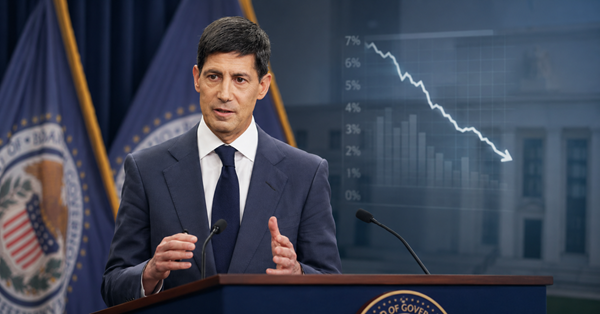
When Kevin Warsh took the gavel in late May and delivered a stripped-down, forward-guidance-free first press conference in June, the read was unanimous. Half the committee had penciled in hikes, the statement had been gutted of any easing language, and the new chair refused to submit his own dot. Wall Street did the obvious thing and started pricing a September hike, with the funds rate moving from roughly 3.6 percent toward something closer to 3.9 percent. Bank of America went further and called for three quarter-point hikes on the year. The label stuck fast. Warsh the hawk.
We were skeptical of that framing then and we are more skeptical now. Not because Warsh is secretly dovish in the Powell mold, but because the market took a communication style and mistook it for a policy path. Those are two different things, and the gap between them is where the opportunity sits.
Listen to what he actually said in Sintra on Wednesday. Inflation expectations over the prior four weeks have come down. Inflation risks have come down. Energy prices have come down substantially since the United States and Iran signed the memorandum of understanding that wound down the war, and while they sit a bit above pre-conflict levels, the direction is unmistakably lower. That is not the vocabulary of a man reaching for the tightening lever. That is a chair building the on-the-record case for why he does not have to.
Pair that with what he would not say. Asked directly whether the Fed would raise rates, he declined to give any prediction at all. He has made a genuine principle out of refusing forward guidance, and the market keeps reading that silence as latent hawkishness. But silence is not a hike. If anything, a chair who genuinely intended to tighten in September would have every incentive to prep the ground for it, the way central bankers always have. Warsh is doing the opposite. He is cataloguing the reasons inflation may have already peaked while keeping his hands conspicuously off the wheel.
The setup underneath his comments does most of the work for him. The May inflation surge to 4.2 percent was an energy story, driven by the war’s effect on gas prices. That war is over. Gas is falling. Core, which strips out the food and energy noise, was already running cooler at 2.9 percent and had ticked down month over month. If oil and gas keep drifting back toward prewar levels, the headline number mechanically follows, and Warsh gets to watch inflation decline without spending a single hike to make it happen. He as much as told you this is the plan when he flagged that the persistent-inflation threat has moderated and cited both survey expectations and bond-market breakevens as evidence.
There is a subtler tell in his AI framing, and it matters for the medium term. Warsh has been consistent that the AI capex boom shows up first in demand but that supply follows, and that over time artificial intelligence expands the economy’s productive capacity and eases inflationary pressure. A chair who believes disinflation is coming from the supply side has a built-in reason to be patient. Why tighten aggressively into a cost shock you expect to fade, and into a productivity wave you expect to disinflate? That is the intellectual architecture of someone looking for permission to hold, not to hike.
None of this makes him a rate-cutter. The price-stability vow is real. He told the room that anyone expecting the Fed to tolerate inflation above 2 percent would be disappointed, and he leaned hard on independence when the subject of White House pressure came up. He clearly wants the credibility that comes from being seen as willing to hike. Our read is that the willingness is genuine but the intention is conditional, and the conditions are quietly resolving in his favor. The single real risk to the hold thesis is a hot labor print reducing the pressure to cut while giving cover to demonstrate resolve, so Thursday’s jobs number is the thing to watch, not another parsing of his tone.
So here is the practitioner takeaway. The market priced Warsh as a hawk based on how he talks. We think he governs as a patient holder who would very much prefer that falling energy and rising productivity do his disinflating for him. If that is right, the risk is asymmetric. A hawk who does not hike is a dovish surprise relative to what is priced, and dovish surprises relative to a hawkish setup are exactly the conditions that move the assets people buy when they doubt the currency.
Which brings us to the metals and the coin down the hall from them. Gold does not need cuts to work here. It needs real rates that stop rising and a market that slowly realizes the hiking path it feared is not arriving. A Warsh who holds while inflation grinds lower keeps real rates capped and hands gold the quiet backdrop it likes best, the kind where nothing dramatic happens and the metal simply stops being pressured. Bitcoin plays the same theme with more leverage and more noise. It runs on the pure liquidity read, so a repriced-lower hiking path tends to light it up faster and drop it harder, and the correlation to risk assets means it is as much a bet on the AI-fueled equity bid staying alive as on the monetary story. We hold gold for the savings function and treat bitcoin as the higher-beta expression of the same doubt, not as a replacement for it. If the hawk that was priced turns out to be a holder, both benefit, and gold gets to do it with a steadier hand.