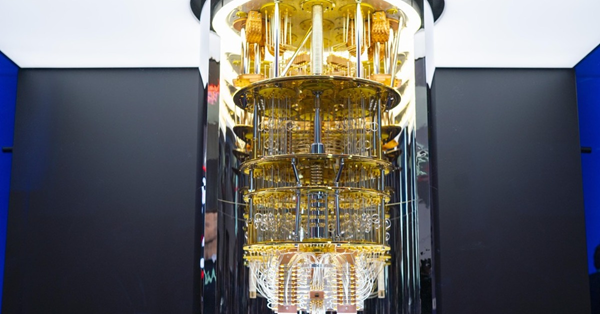
There’s a version of IBM stuck in everyone’s head: the beige mainframe giant from your dad’s office, a slow-moving relic kept alive by legacy contracts. That version is increasingly wrong. In 2026, IBM is doing something far more interesting than coasting. It’s building the factory for an entire industry that doesn’t fully exist yet, and the U.S. government just wrote a billion-dollar check to help.
America’s first quantum foundry
In May, IBM and the U.S. Department of Commerce announced Anderon, billed as America’s first pure-play quantum chip foundry. The structure is the eye-catching part. The government is putting up roughly $1 billion in CHIPS Act incentives, IBM is matching it with another $1 billion in cash plus intellectual property, assets, and staff, and the whole thing anchors at the Albany NanoTech complex in New York. IBM shares jumped on the news, and it’s not hard to see why.
Think about what a foundry actually means here. Anderon isn’t designed to make chips only for IBM. It’s meant to fabricate quantum wafers for the entire field, the way TSMC fabricates conventional chips for companies that don’t own fabs. If quantum computing becomes a real industry, the company that runs the foundry sits underneath all of it, selling shovels to every miner in the gold rush. That’s a fundamentally different and more durable position than being one of many companies racing to build the best machine.
And the government framing is explicit. This was pitched as securing American quantum leadership, part of a broader $2 billion set of CHIPS commitments spread across nine quantum companies, with IBM as the headliner. When Washington decides an emerging technology is a matter of national competitiveness and starts funding the manufacturing base, that tends to pull private capital and talent in behind it. IBM has spent decades working alongside agencies like NIST, DARPA, and the Department of Energy, and Anderon turns that relationship into industrial policy.
The technical edge that actually matters
Here’s the part worth getting a little excited about without drowning in jargon. IBM is moving quantum chip production onto 300-millimeter wafers, the same large format the modern semiconductor industry uses, instead of the smaller 200mm wafers most quantum research has relied on.
Why care? Because bigger wafers and modern tooling mean IBM can iterate dramatically faster. IBM’s research director has said the move to 300mm produces devices something like 30 times faster, with far more complexity per cycle. In a field where the entire challenge is learning fast enough to make qubits reliable, iteration speed is close to everything. It’s the difference between hand-building prototypes in a lab and running an automated line around the clock. This is IBM trying to turn quantum hardware from a craft into a manufacturing discipline, and that shift is arguably more important than any single qubit-count milestone.
It also feeds directly into the bigger goal. IBM has put a date on the wall: a large-scale, fault-tolerant quantum computer called Starling by 2029, which it claims could run tens of thousands of times more operations than today’s machines. In June, the company backed that ambition with a commitment to spend more than $10 billion on quantum over five years. The foundry is how you actually build toward a target like that instead of just talking about it.
This isn’t vaporware
The easy criticism of quantum is that it’s perpetually ten years away. IBM’s answer is that the era has already started, and it has receipts. The company has deployed more than 90 quantum systems worldwide, more quantum computers than the rest of the industry combined by its own count, running through the cloud and on-site at places like the Cleveland Clinic, the University of Tokyo, and a string of national research centers. Its ecosystem already spans more than 325 Fortune 500 companies, startups, and government agencies using these machines for real work in chemistry, materials science, and biology.
That’s the honest dividing line. Quantum computers still won’t run your email or your company’s payroll, and anyone selling a “quantum app” for everyday business is worth a raised eyebrow. But in the science-heavy domains where they shine, modeling molecules, materials, and chemical reactions, the work is genuinely happening today, not in some hypothetical future. The hype is real; it’s just pointed at the right targets.
The boring business funding the exciting one
None of this would be as compelling if IBM were a struggling company making a desperate bet. It isn’t. The first quarter showed revenue up around 9% to roughly $15.9 billion, software up double digits, and a surprising 51% surge in mainframe revenue as the new z17 cycle ran hot. The company is generating billions in free cash flow and just raised its dividend again.
That matters because it changes the character of the quantum bet entirely. Plenty of quantum players are pre-revenue startups burning cash and praying for the breakthrough before the funding runs out. IBM is bankrolling its moonshot with a profitable, cash-gushing enterprise business. The mainframe and software divisions are essentially buying IBM the runway to be patient about quantum in a way almost none of its competitors can match. The one soft spot worth watching is consulting, which has lagged as enterprises stretch out deal cycles, and a pickup there would signal corporate spending loosening up.
So what’s the story?
The drab way to say it is “IBM has a stable core business and an interesting long-term R&D program.” The more accurate way to say it is this: a 115-year-old company that everyone wrote off is positioning itself to own the manufacturing layer of a potentially enormous industry, the U.S. government is co-investing because it views that industry as strategically essential, and the whole effort is funded by a legacy business that’s quietly throwing off more cash than its reputation suggests.
The caveats are real, and worth keeping in view. Quantum timelines slip notoriously, 2029 is a long way off, and “fault-tolerant” is a high bar that has humbled optimists before. But the combination of a national-priority tailwind, a genuine manufacturing edge, an installed base that already exists, and a cash machine paying for all of it is a far more compelling story than the sleepy-blue-chip caricature would have you believe. Whether any of that fits your own timeline and risk appetite is a separate question, and one only you can answer. But it’s a story worth actually paying attention to.