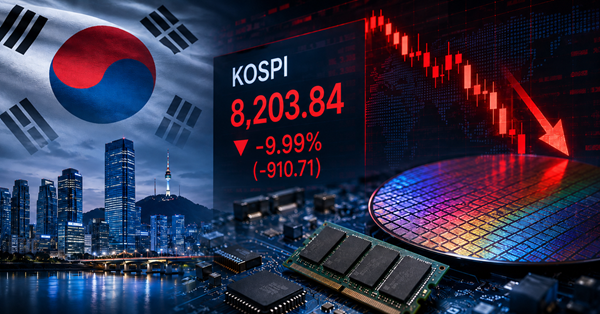
The most violent session in global markets this morning did not happen on a US exchange. It happened in Seoul, where the Kospi closed down roughly ten percent and the Korea Exchange had to halt trading twice to keep the slide from becoming a stampede. SK Hynix and Samsung Electronics, the two names that have carried that index for the better part of a year, both fell more than twelve percent. By the time the dust settled the damage had already booked a flight across the Pacific, with Micron, SanDisk, Seagate and Western Digital all gapping lower in our premarket and the broad semiconductor complex following them down.
If you have been watching this tape the way I have, none of this should feel like a bolt from the blue. It feels like the fourth act of a play we have been sitting through since early June.
What actually happened
The mechanics are worth getting right before we reach for a narrative. The Kospi opened roughly flat, then fell through one round number after another in quick succession. A sell-side circuit breaker fired in the late morning, and a heavier program-trading halt came in the afternoon as the index kept bleeding. South Korean and Japanese markets had both run hard into this, with regional benchmarks up forty percent or more on the year, which is precisely the condition that turns an ordinary pullback into a fire. When everyone is leaning the same way, the exit is narrow.
The seller of record was foreign money. Overseas investors had been the marginal buyer on the way up, and they reversed hard, dumping chip shares into a market that had no natural bid to meet them. That is the difference between a correction and a rout. A correction is sellers meeting buyers at a lower price. A rout is sellers meeting no one.
There is a piece of trivia buried in the wreckage that tells you how concentrated this trade had become. At one point during the recent turbulence Samsung lost its spot as the largest company on the Kospi to SK Hynix for the first time in twenty-six years, then took it back as the two traded blows. When the top two seats on an entire national index are swapping places on the strength of memory pricing, you are no longer looking at a diversified market. You are looking at a leveraged bet on one product cycle wearing the costume of a stock index.
Why it crossed the ocean
The reason a bad morning in Seoul becomes a bad premarket in New York is not sentiment. It is supply. SK Hynix and Samsung, together with Micron, manufacture essentially all of the world’s DRAM and NAND. There is no fourth chair at that table. So when the two Korean names get repriced, the market has no honest way to argue that the third one belongs at a different multiple. Micron competes directly with SK Hynix in high-bandwidth memory, the specific flavor of DRAM bolted next to every AI accelerator, and that is the exact product the whole bull case rests on. Contagion here is not a mood. It is arithmetic.
That is also why this keeps happening. This is the third or fourth time this year the same script has run: something rattles the Korean complex, the circuit breakers trip, and US memory names open lower in sympathy the next morning. It happened in March on energy fears. It happened in May on a comment from a Korean policymaker. It happened in early June when Broadcom’s AI chip guidance came in light. Each time, the US names took the better part of two weeks to work the damage off. That is not a prediction. It is just the rhythm this group has been trading to.
The question underneath the price
Strip away the circuit breakers and the percentage moves and you are left with one unresolved argument, the same one that has been sitting at the center of this trade all year. Is memory cyclical or is it structural.
The bull answer is that this time the cycle is broken in the buyer’s favor. HBM supply is contracted out through the year, the supply-demand gap is the widest it has been in over a decade, and the three makers have figured out that feeding AI pays far better than feeding consumers and have no incentive to flood the market. The bear answer is the oldest one in the semiconductor business: every memory peak in history looked permanent right up until capacity caught up and prices fell out of bed, and the firms warning that today’s margins are a ceiling rather than a floor have been right before.
Here is the honest part. Today’s tape does not resolve that argument. A forced unwind driven by foreign outflows and crowded positioning tells you a great deal about how many people owned the trade and almost nothing about whether the trade was correct. Mechanical selling and a broken thesis produce the same red candle. They are not the same event, and the only way to tell them apart is to watch what comes next.
What I am actually watching
Two days from now Micron reports. That is the real referee. Every word of guidance on HBM pricing, on whether the supply commitments hold, on whether demand is accelerating or merely holding, lands into a market that has just told you how fragile its conviction is. A strong print into this kind of fear is the setup that produces a snap-back. A soft one, or even an in-line one with cautious language, hands the cyclical skeptics their moment and turns this morning’s mechanical flush into something with a fundamental signature.
Between now and then, the tells are not in the chip prices themselves. They are in the plumbing. Watch whether foreign selling in Korea keeps its intensity or starts to ease. Watch whether the won steadies. Watch whether the weakness stays quarantined inside semiconductors or starts leaking into the rest of tech, because the first is a position unwind and the second is a regime change. And watch the long end of the Treasury curve, which has been climbing on its own schedule and quietly raising the cost of owning anything priced on far-off earnings.
The thing I keep coming back to is that this is the same handful of companies that physically build the memory inside every AI system on the planet. These are not story stocks. If the market is willing to take the picks-and-shovels names down twelve percent in a session, it is asking a question about the entire AI capital structure, not just about Korea. The answer to that question is not in this morning’s quote. It starts arriving Wednesday after the close.